- Home
- Services
-
DIGITAL MARKETING
 Search Engine Optimization
  Social Media Optimization
- Guest Posting Service
 Brand Reputation Management
 - Apps Marketing
- Facebook Advertising
 PPC Management
  SEO Migration & Consultancy
  Local Business Listing
WEB DEVELOPMENT
- Core PHP Web Development
- E-Commerce Web Development
 Open Source Development
  Content Management System
 - Database Development
 Website Maintenance
 Website Migration
WEB DESIGN
- Custom Website Design
- E-Commerce Web Design
- Flash Designing
- Facebook Page Design
 Re-Designing
  Logo Designing & Branding
 - PSD to HTML Development
Application Development
 Web Application Development
 - iPhone App Development
- Android App Development
- Window App Development
- Facebook App Development
Other Services
 Content Writing Service
  Hire Dedicated Resource
-
- Packages
- About Us
- Contact Us


UI/UX Strategy
Enterprise-grade UX demands more than aesthetics — it demands evidence. We partner with scaled teams to architect data-informed user experiences that reduce friction, accelerate activation, and compound loyalty, all while staying brand-consistent and technically sound.
15+
Years Experience500+
Projects Delivered30+
Countries Served99%
Client RetentionRequest a Project Quote
Get a customized technical architecture plan from our experts.
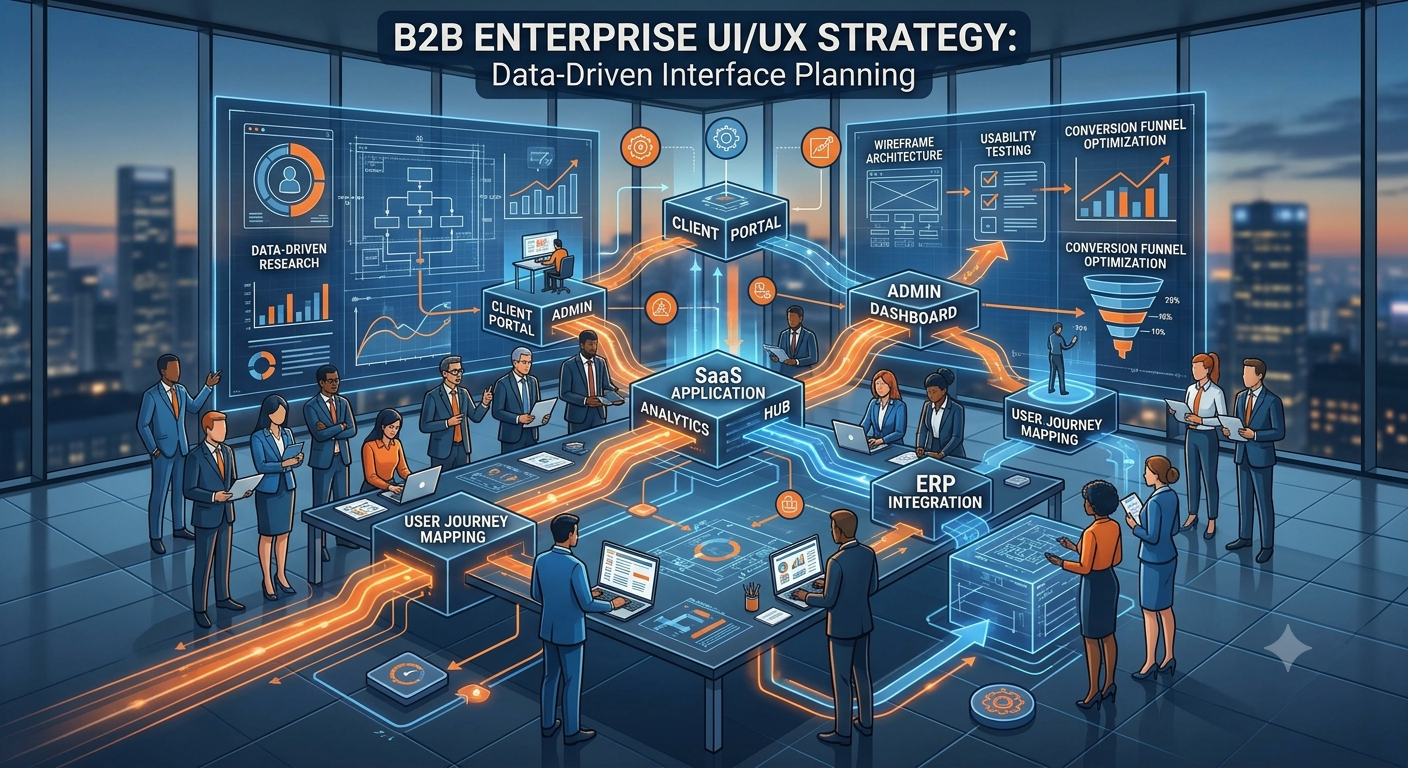
UI/UX Strategy: Data-Driven User Experience & Interface Planning
In the enterprise landscape, a beautiful interface is worthless if it doesn’t drive measurable action. Corporate buyers, technical stakeholders, and enterprise consumers do not have the time to navigate confusing layouts, decipher vague user journeys, or wait for bloated pages to load. They demand frictionless, intuitive digital experiences that guide them effortlessly from entry to conversion.
Our UI/UX strategy eliminates the guesswork. We replace assumptions with hard data, mapping complex behavioral psychology and business logic into every wireframe, user flow, and pixel. At Technologus, we do not just design screens; we architect high-performance digital environments engineered to qualify leads, build instant trust, and accelerate your enterprise sales cycle.
The True Cost of Subjective Design
Getting a stakeholder to click on your website is only the first step. If they cannot find the specific solutions they need within seconds, they will leave—taking your ad budget and potential revenue with them.
- First Impressions are Final: Users form an opinion about your digital authority in milliseconds. An outdated or confusing interface quietly signals risk to enterprise buyers.
- Friction Kills Conversions: One extra step, a confusing form, or a cluttered dashboard drastically increases drop-off rates across your entire funnel.
- You Pay for Bounces: Every visitor who abandons your site due to poor navigation is a wasted marketing dollar. Great UI/UX plugs the leaks that your campaigns cannot fix on their own.
Our End-to-End UI/UX Strategic Process
We guide you from initial audience research through to pixel-perfect developer handoff. Every deliverable is mapped against your core business objectives.
UX Research & Architecture
We start by understanding how your users actually behave. This includes persona mapping, competitor analysis, heuristic audits, and planning scalable information architecture so users never feel lost.
Wireframing & Interactive Prototyping
We build low and high-fidelity wireframes and clickable prototypes. This allows for rapid iteration cycles and stakeholder validation before a single line of code is written.
Visual UI & Design Systems
We craft brand-aligned visual systems, ensuring responsive, mobile-first consistency across all touchpoints. We build scalable design token libraries so your internal teams can maintain visual consistency long after launch.
CRO & Developer Handoff
Design is only as good as its execution. We provide annotated, pixel-perfect developer files, accessibility (WCAG) checks, and A/B test-ready variations to ensure the final product looks and functions exactly as intended.
Measuring Experience Through Real Metrics
We do not evaluate success based on aesthetics; we measure it by how the design impacts your bottom line. We monitor task success rates to ensure users can complete key actions effortlessly. By analyzing heatmaps, scroll depth, and bounce rates, we identify exactly where users lose interest. Ultimately, our success is measured by the lift in your conversion rates—be it demo requests, software sign-ups, or direct B2B inquiries.
Why Choose Technologus
Enterprise-grade UX demands more than aesthetics — it demands evidence. We partner with scaled teams to architect data-informed user experiences that reduce friction, accelerate activation, and compound loyalty, all while staying brand-consistent and technically sound.
We Design for Outcomes, Not Awards
A beautiful interface that doesn't convert is just expensive art. From day one, we tie every design decision to a business metric — conversion rate, activation, retention, revenue. If a design choice can't be connected to an outcome you care about, we question why we're making it. You're not paying for decoration; you're investing in a measurable return.
Real Data Before a Single Pixel
Most agencies open Figma on day one and guess. We don't. We instrument, research, and map your actual user behaviour first, so every wireframe and every screen is built on evidence rather than assumption. This single difference is why our designs work from launch day — not after three rounds of painful iteration.
Senior Strategists, Not Handoffs to Juniors
Your product deserves people who understand user psychology, business goals, and technical constraints all at once. Our senior product thinkers stay on your account from discovery to delivery. You talk to the people actually doing the work, and the designers who ideate are the same ones who hand off clean, annotated specs your developers can actually build — no lost-in-translation moments.
We Build for Scale, Not Just This Sprint
The interfaces we design today should still hold up when your team doubles and your product grows five features. That's why we lay solid foundations — clean information architecture, reusable components, and design systems where appropriate — so you aren't paying for a redesign every 12 months. We plan for version three on day one.
Frequently Asked Questions
It's an approach where interface decisions — layout, navigation, visuals, and flow — are guided by measurable user behaviour (analytics, A/B tests, heatmaps, usability studies) rather than intuition or stakeholder opinion. It turns design from an art project into an evidence-based process you can measure and improve.
UX (User Experience) is the strategic, analytical foundation—how the product works, how information is structured, and how the user feels navigating it. UI (User Interface) is the visual execution—the typography, colors, buttons, and micro-interactions that make the UX strategy come to life on the screen.
Timelines vary based on the complexity of the enterprise application or website. A targeted UI refresh may take a few weeks, while end-to-end UX research, prototyping, and design systems for a complex B2B platform can take several months. We establish clear timelines and deliverables during our initial technical consultation.
We do both. If your current platform has a high bounce rate or poor conversion metrics, we can perform a comprehensive UX audit to identify the bottlenecks. We then rebuild the interface around actual user behavior data to drastically improve performance.
Yes. We build clean, annotated handoffs — Figma files, specs, and design tokens — designed to make your developers' lives easier. Whether you have an in-house team or use a third-party dev agency, we collaborate seamlessly and stay available during implementation to ensure the build matches the design.
Absolutely — and often this is where we create the fastest wins. We can run a UX audit or heuristic evaluation to identify leaks, drop-off points, and conversion blockers in your current product, then prioritise fixes by impact. Most live products have easy, high-ROI improvements hiding in plain sight.
Yes. Accessibility isn't an add-on for us; it's part of designing for real humans. We build to WCAG 2.1 AA standards as a baseline — proper contrast, keyboard navigation, screen-reader compatibility — so your product is usable by everyone and ready for compliance requirements.
Unlike traditional design agencies, our UI/UX strategy is engineering-led. We create annotated design files and comprehensive design systems specifically for developers. Because we understand the underlying code architecture, we never design impossible or poorly-optimized interfaces.
They're closely related. Data-driven design uses historical evidence to inform decisions. Adaptive or predictive UX takes it a step further — using that data (often via lightweight models) to change the interface in real time, such as skipping a welcome tour for a returning user or surfacing help when someone is likely to abandon. We apply both where they genuinely improve results, always with user transparency and consent.
Yes. Design doesn't stop at launch. We offer ongoing retainers for continuous improvement, A/B testing, new feature design, and design-system maintenance, so your product keeps evolving based on what the data tells us after release.
Ready to Engineer Your Next Digital Asset?
Partner with an agency that understands complex business logic, robust database architecture, and uncompromised security. Let's build a software solution tailored exclusively for your operations.
Request a Technical Consultation



















Technologus
- B - 31, Sector - 6 NOIDA (INDIA)
- +91-9873469643 / 9212742139
- sales@technologus.com