- Home
- Services
-
DIGITAL MARKETING
 Search Engine Optimization
  Social Media Optimization
- Guest Posting Service
 Brand Reputation Management
 - Apps Marketing
- Facebook Advertising
 PPC Management
  SEO Migration & Consultancy
  Local Business Listing
WEB DEVELOPMENT
- Core PHP Web Development
- E-Commerce Web Development
 Open Source Development
  Content Management System
 - Database Development
 Website Maintenance
 Website Migration
WEB DESIGN
- Custom Website Design
- E-Commerce Web Design
- Flash Designing
- Facebook Page Design
 Re-Designing
  Logo Designing & Branding
 - PSD to HTML Development
Application Development
 Web Application Development
 - iPhone App Development
- Android App Development
- Window App Development
- Facebook App Development
Other Services
 Content Writing Service
  Hire Dedicated Resource
-
- Packages
- About Us
- Contact Us


iOS App Development
At Technologus, we do not compromise on performance. We build enterprise-grade, native iOS applications that feel instantly familiar to Apple users.
15+
Years Experience500+
Projects Delivered30+
Countries Served99%
Client RetentionRequest a Project Quote
Get a customized technical architecture plan from our experts.
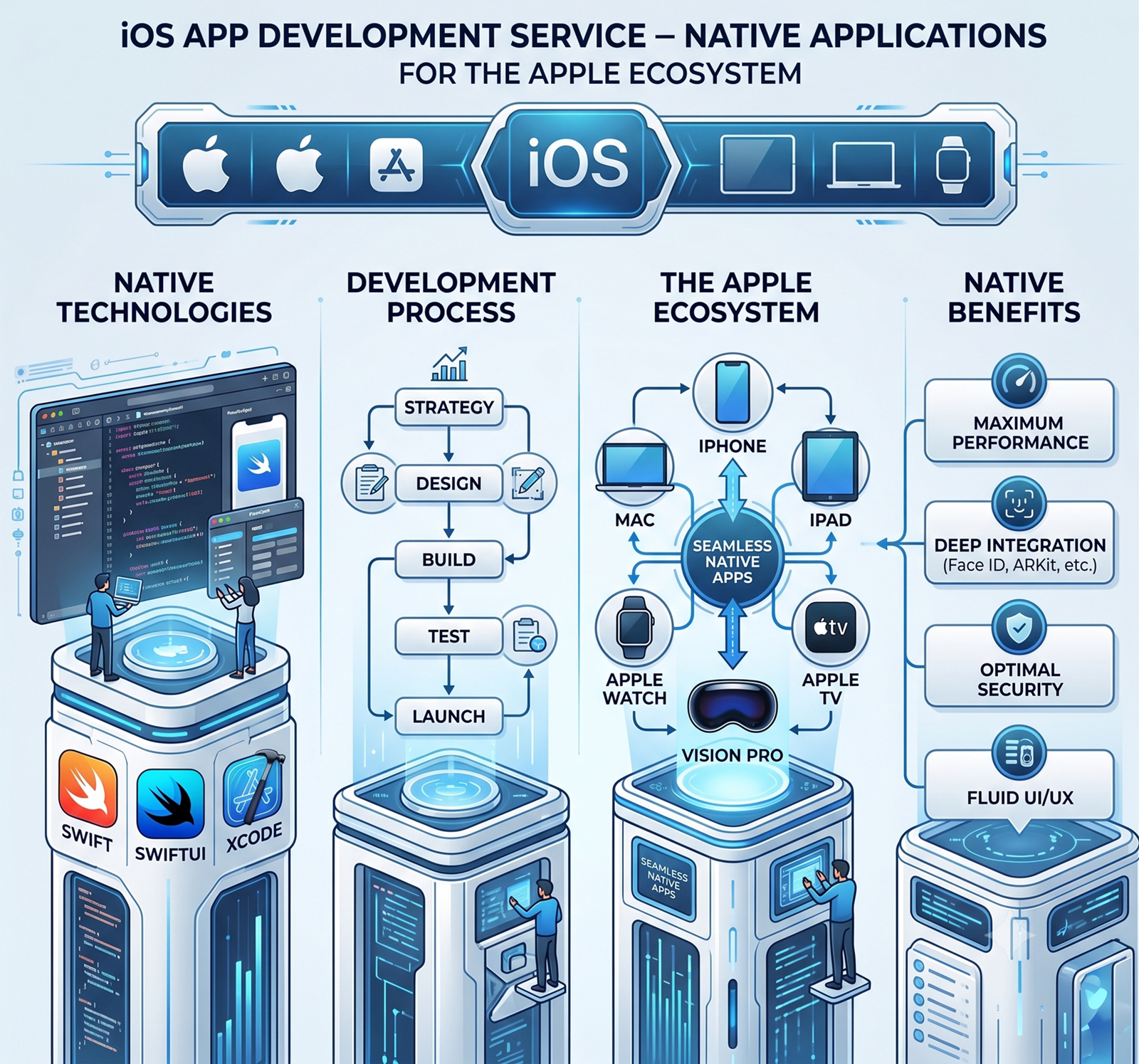
iOS App Development – Native Applications for the Apple Ecosystem
There’s a reason Apple users are loyal. They expect things to just work — smooth animations, instant touch response, clean interfaces, and a sense that someone genuinely cared about the details. That’s the standard your iOS app needs to meet.
At Technologus, we build native iOS applications that live up to that expectation. Not cross-platform shortcuts. Not web apps wrapped in a shell. Real, native apps written in Swift and SwiftUI, designed to take full advantage of Apple’s hardware, frameworks, and design language.
Whether you’re launching a startup idea, extending your business to mobile, or rebuilding an outdated app, we help you ship something that feels genuinely Apple — and actually drives results for your business.
Why Native iOS Development?
Before we talk about what we do, it’s worth explaining why native matters.
When you build natively for iOS, you’re writing code that speaks directly to Apple’s frameworks. There’s no translation layer, no bridge, no “close enough.” Your app runs faster, integrates more deeply with the device, and follows the patterns Apple users already know and love.
Here’s where native iOS development clearly outperforms cross-platform alternatives:
- Performance-critical apps — Games, AR experiences, video processing, real-time audio. Anything where milliseconds matter, native Swift is the right call.
- Deep system integration — HealthKit, HomeKit, CarPlay, Siri Shortcuts, advanced camera controls, background processing. These work best (and often only) with native code.
- Security-sensitive applications — Keychain, biometric authentication, memory-safe data handling. Cross-platform frameworks add an attack surface that native apps simply don’t have.
- Long-term maintainability — Apple releases new iOS features every year. Native apps can adopt them immediately. Cross-platform frameworks often lag months — sometimes years — behind.
If your app will exist for more than a few months and quality actually matters to your brand, native is the investment that keeps paying off.
What We Offer
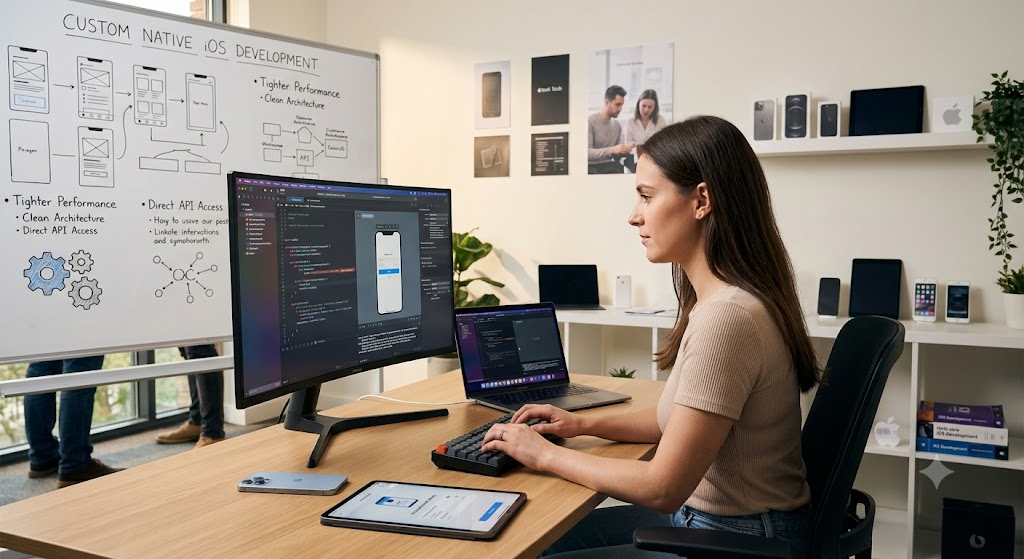
Custom Native iOS App Development
We build iOS applications from the ground up using Swift, SwiftUI, and UIKit — Apple’s recommended and most powerful development stack. Every line of code is written specifically for iOS, which means tighter performance, cleaner architecture, and direct access to every API Apple offers.
Whether it’s a consumer app, a B2B tool, or an internal enterprise app, we engineer it to feel native because it is native.
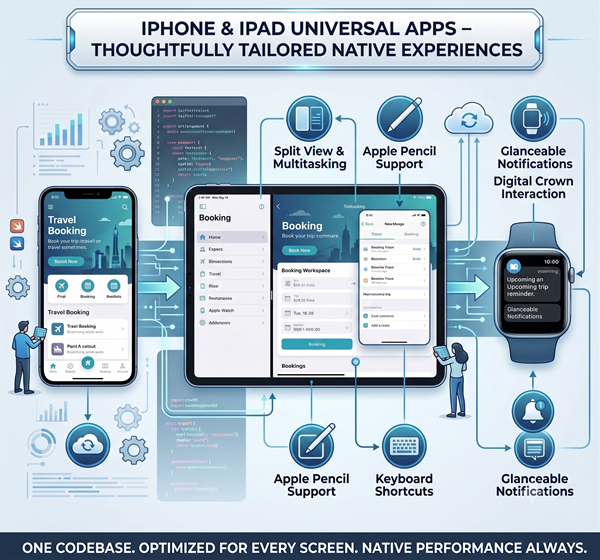
iPhone & iPad Universal Apps
The Apple ecosystem isn’t just iPhones anymore. We build universal apps that adapt beautifully across iPhone, iPad, and Apple Watch — taking advantage of each device’s unique capabilities instead of just stretching the same interface across screens.
iPad users get proper multitasking, split view, and Apple Pencil support. Apple Watch users get quick, glanceable interactions. Same codebase, thoughtfully tailored.
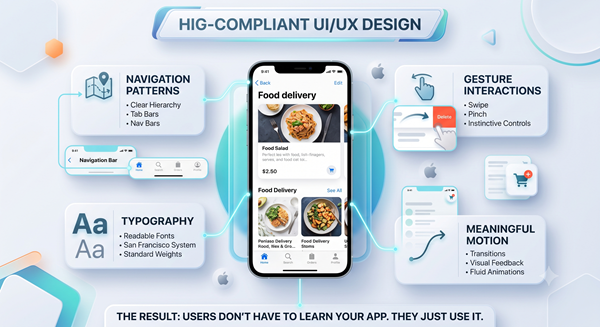
UI/UX Design That Follows Apple’s Human Interface Guidelines
Apple has design expectations, and so do your users. We design interfaces that conform to Apple’s Human Interface Guidelines (HIG) — navigation patterns, gesture interactions, typography, and motion that feel familiar and intuitive.
The result: users don’t have to learn your app. They just use it.
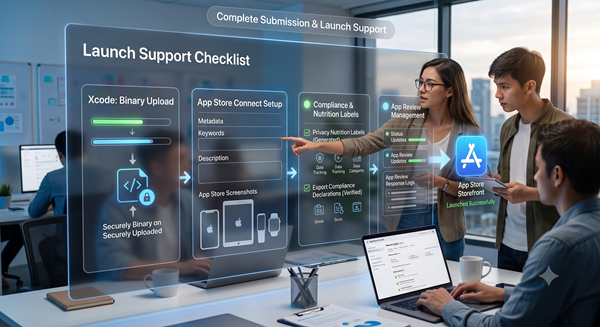
App Store Submission & Launch Support
Getting an app into the App Store isn’t just about uploading a binary. There’s metadata, privacy nutrition labels, export compliance declarations, screenshots, App Review responses, and a whole checklist of details that trip up first-time submitters.
We handle the entire submission process — binary upload via Xcode, App Store Connect setup, review cycle management, and post-launch fixes — so you launch smoothly and stay compliant.
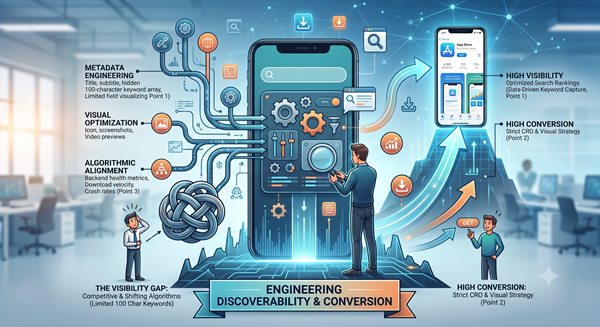
App Store Optimization (ASO)
A great app that nobody finds doesn’t help your business. We optimize your app’s title, description, keywords (limited to 100 characters total), and visuals to improve discoverability and conversion within the App Store.
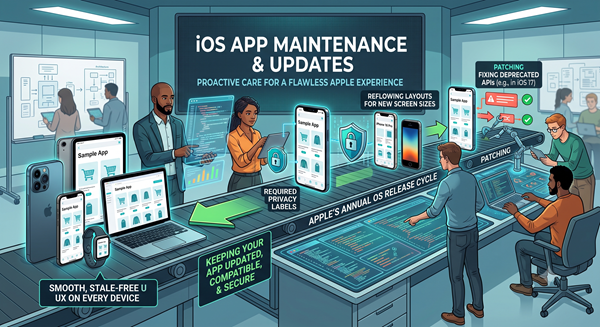
iOS App Maintenance & Updates
Apple’s annual OS release cycle creates real maintenance overhead. New screen sizes, deprecated APIs, privacy requirements — they all change yearly. We keep your app updated, compatible, and secure with every iOS release, so it never feels stale or broken.
Our Development Process
We follow a structured, transparent process — but we stay flexible enough to adapt to your reality.
Discovery & Requirements —
We define the vision, target devices (iPhone, iPad, Apple Watch), distribution channel (App Store, TestFlight, or enterprise), success criteria, and technical scope.
Architecture & Technical Design —
We choose the right framework (SwiftUI, UIKit, or a hybrid), plan backend connectivity, define data persistence, and map out any third-party integrations or special entitlements (HealthKit, ARKit, CoreML).
UI/UX Design & Prototyping —
Wireframes and high-fidelity designs built to Apple’s HIG, with interactive prototypes so you can feel the app before a single line of production code is written.
Engineering & Integration —
Agile development in two-week sprints. You see progress continuously, not at the end of six months.
Testing & QA —
Functional, regression, accessibility (VoiceOver, WCAG), and device-compatibility testing across Apple’s active device matrix — on simulators and real hardware.
Submission, Review & Launch —
Full App Store submission handling, including metadata, privacy labels, and review response.
Post-Launch & Maintenance —
Monitoring, updates, and continuous improvement based on real user behavior.
Why Choose Technologus
Choosing the right iOS app development partner determines whether your app becomes a trusted, high-performing tool that users love — or a fragile, slow, and frustrating experience that drives them away. We don’t just build apps; we engineer intelligent, native solutions for the Apple ecosystem that are fast, secure, and designed to scale with your business — from first launch to future updates, all built on a foundation of performance, clarity, and long-term maintainability.
We Build Native — Not Cross-Platform in Disguise
A lot of agencies quietly build your “iOS app” in React Native or Flutter and ship a single codebase to both platforms. That’s fine for some use cases, but it’s not what we do when native is the right call. We write real Swift and SwiftUI, which means your app gets the full performance envelope of Apple’s hardware, immediate access to new iOS features every June, and the kind of smooth 120fps interactions that cross-platform bridges simply can’t reliably deliver. When your brand reputation depends on how the app feels, native is non-negotiable.
Security Is Built In, Not Bolted On
Apple enforces App Transport Security (HTTPS by default), and we go further. Keychain integration, biometric authentication (Face ID / Touch ID), memory-safe data handling, encryption, and strict compile-time checks are part of how we build — not something we add at the end. If your app handles payments, health data, or sensitive business information, that matters. Swift’s strict typing and lack of a proprietary runtime also mean a smaller attack surface compared to cross-platform frameworks.
We Design for Apple Users, by Apple Users
We don’t design generic mobile screens and hope they work on iOS. Every interaction, animation, and navigation pattern is built around Apple’s Human Interface Guidelines — because that’s what your users expect. Tab bars behave like tab bars. Sheets dismiss the way users expect. Gestures feel natural. This isn’t just aesthetics; it’s about reducing friction so users complete the actions that matter to your business.
We Stay With You After Launch
An iOS app is never really “done.” Apple ships a major OS update every year, device screens change, new APIs arrive, and old ones get deprecated. Many agencies disappear after the App Store launch. We stick around — handling compatibility updates, performance tuning, new feature development, and App Review responses so your app stays healthy for years, not just weeks.
Frequently Asked Questions
Native iOS development uses Swift and Apple’s own frameworks (SwiftUI, UIKit) to build apps specifically for iOS. Cross-platform tools like Flutter or React Native write one codebase that outputs apps for multiple platforms. Native gives you better performance, deeper system integration, stronger security, and faster access to new iOS features — but requires a separate codebase from Android.
It depends on complexity. A focused MVP can take 10–14 weeks. A full-featured app with backend integration, custom animations, and App Store submission usually runs 16–24 weeks. We give you a realistic timeline after the discovery phase — no inflated promises.
Yes. We are full-stack engineers. An iOS app is just the presentation layer; it requires a robust, secure server environment to function. We architect the databases, build the administrative dashboards, and create the custom APIs necessary to sync data instantly to the app.
Yes. We manage the entire process — binary upload, App Store Connect setup, metadata, privacy nutrition labels, screenshots, and responding to App Review feedback if Apple requests changes. You stay informed the whole way.
Absolutely. We regularly take over existing codebases — including Objective-C apps that need modernizing to Swift, apps with technical debt, or projects abandoned by a previous developer. We audit first, then stabilize and improve.
We do not recommend simply "wrapping" a website into an app shell—Apple routinely rejects these. However, we can take the core functionality and database of your existing website, build a custom REST API, and engineer a brand new native iOS interface that connects to your current system.
It can. We build universal apps that adapt to iPhone, iPad, and Apple Watch. We’ll discuss your target devices during discovery and recommend the right scope — sometimes iPad or Watch support makes sense, sometimes it’s a later phase.
Security is part of our development process from the start — not an afterthought. We use Keychain for sensitive data, biometric authentication where appropriate, HTTPS/App Transport Security by default, encryption, and Swift’s memory-safe, strictly-typed language features to minimize vulnerabilities.
Yes. Apple releases a major iOS update annually, which means apps need regular compatibility checks and updates. We offer maintenance plans that cover OS updates, bug fixes, performance monitoring, and new feature development.
Yes. We have experience integrating Apple’s native frameworks — HealthKit, ARKit, CoreML, Vision, HomeKit, Siri Shortcuts, CarPlay, and more. If your app needs deep hardware or OS integration, native development is the only reliable way to do it.
Ready to Engineer Your Next Digital Asset?
Partner with an agency that understands complex business logic, robust database architecture, and uncompromised security. Let's build a software solution tailored exclusively for your operations.
Request a Technical Consultation



















Technologus
- B - 31, Sector - 6 NOIDA (INDIA)
- +91-9873469643 / 9212742139
- sales@technologus.com