
- Home
- Services
-
DIGITAL MARKETING
 Search Engine Optimization
  Social Media Optimization
- Guest Posting Service
 Brand Reputation Management
 - Apps Marketing
- Facebook Advertising
 PPC Management
  SEO Migration & Consultancy
  Local Business Listing
WEB DEVELOPMENT
- Core PHP Web Development
- E-Commerce Web Development
 Open Source Development
  Content Management System
 - Database Development
 Website Maintenance
 Website Migration
WEB DESIGN
- Custom Website Design
- E-Commerce Web Design
- Flash Designing
- Facebook Page Design
 Re-Designing
  Logo Designing & Branding
 - PSD to HTML Development
Application Development
 Web Application Development
 - iPhone App Development
- Android App Development
- Window App Development
- Facebook App Development
Other Services
 Content Writing Service
  Hire Dedicated Resource
-
- Packages
- About Us
- Contact Us


Cross-Platform App Development
We build robust applications using React Native and Flutter. Instead of managing two separate engineering teams for iOS and Android, you maintain a single codebase.
15+
Years Experience500+
Projects Delivered30+
Countries Served99%
Client RetentionRequest a Project Quote
Get a customized technical architecture plan from our experts.
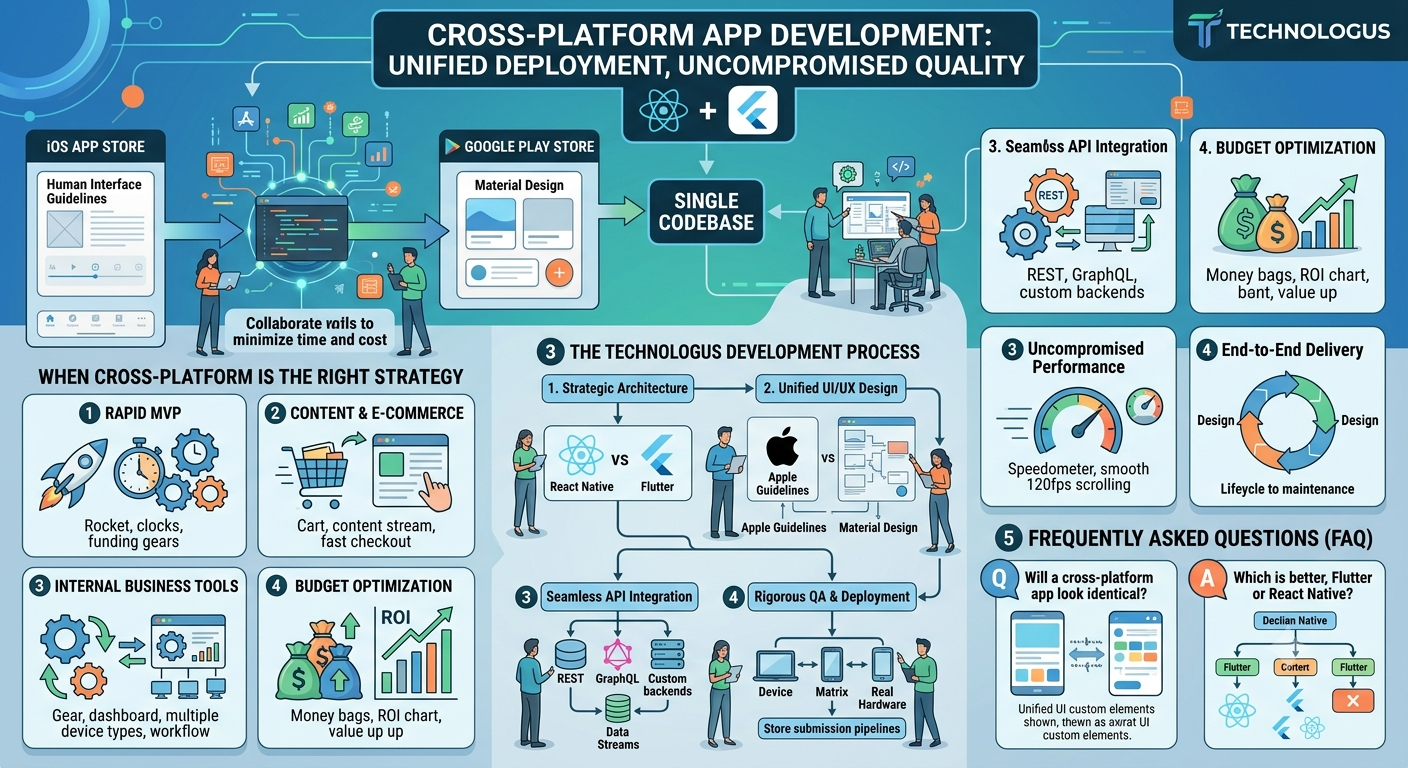
Cross-Platform Development: Unified Deployment, Uncompromised Quality
Native development is powerful, but it isn’t the only way to win. When speed to market, budget efficiency, and unified codebases are your primary business drivers, cross-platform development is the strategic choice.
We build robust applications using React Native and Flutter. Instead of managing two separate engineering teams for iOS and Android, you maintain a single codebase. This significantly reduces development time and long-term maintenance overhead while still delivering a fast, high-quality user experience.
When Cross-Platform is the Right Strategy
Not every application requires deep integration with low-level device hardware. Modern cross-platform frameworks are the ideal solution for:
- Rapid MVPs: Proving your market fit, acquiring early users, and securing stakeholder funding quickly.
- Content & E-commerce Apps: Where consistent UI, fast checkout flows, and data display matter more than complex 3D processing.
- Internal Business Tools: Unifying enterprise operations and workflows seamlessly across diverse employee devices.
- Budget Optimization: Maximizing your return on investment and launching on two platforms for the cost of one.
What We Offer
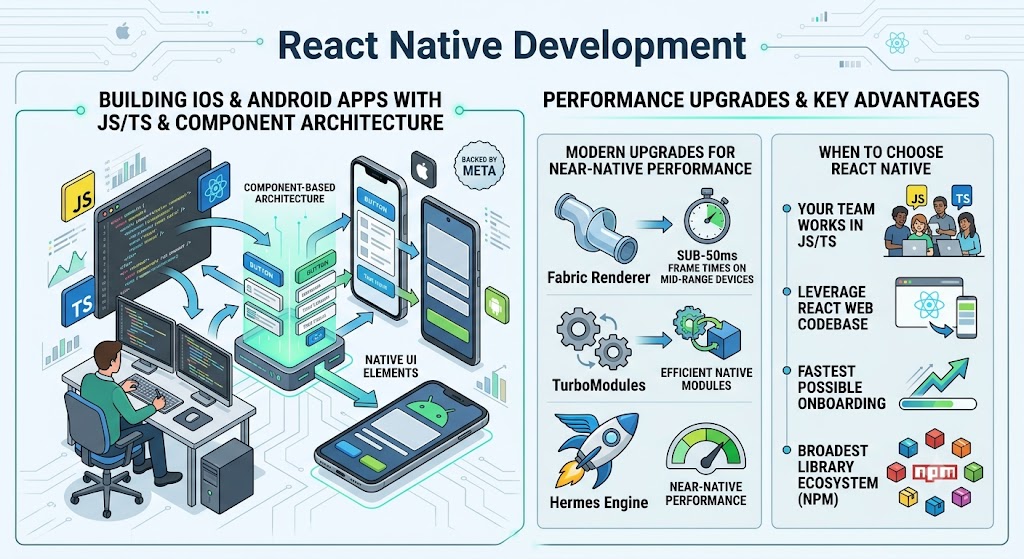
React Native Development
React Native, backed by Meta, lets us build iOS and Android apps using JavaScript or TypeScript and a component-based architecture that maps directly to native UI elements. With modern upgrades like the Fabric renderer, TurboModules, and the Hermes engine, React Native now delivers sub-50ms frame times on mid-range devices and near-native performance for most business apps.
We choose React Native when your team already works in JavaScript, you have a React web codebase to leverage, or you want the fastest possible onboarding and the broadest library ecosystem (NPM) at your fingertips.
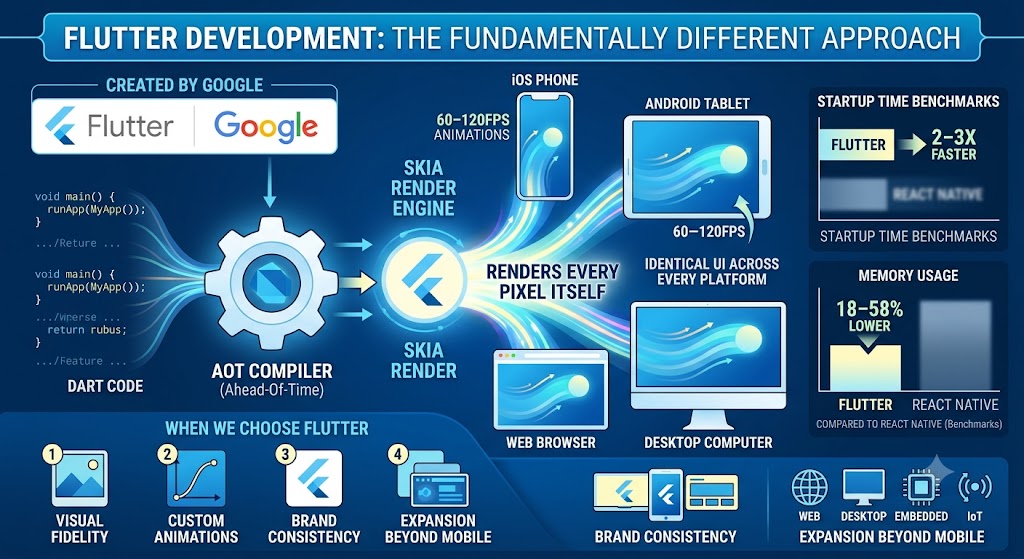
Flutter Development
Flutter, by Google, takes a fundamentally different approach. Instead of bridging to native widgets, it renders every pixel itself using the Skia engine, compiling Dart code directly into native machine code (AOT). The result: 60–120fps animations, identical UI across every platform, and benchmarks showing 2–3x faster startup times and 18–58% lower memory usage than React Native.
We choose Flutter when visual fidelity, custom animations, brand consistency, or expansion beyond mobile (web, desktop, embedded, IoT) are central to your product.
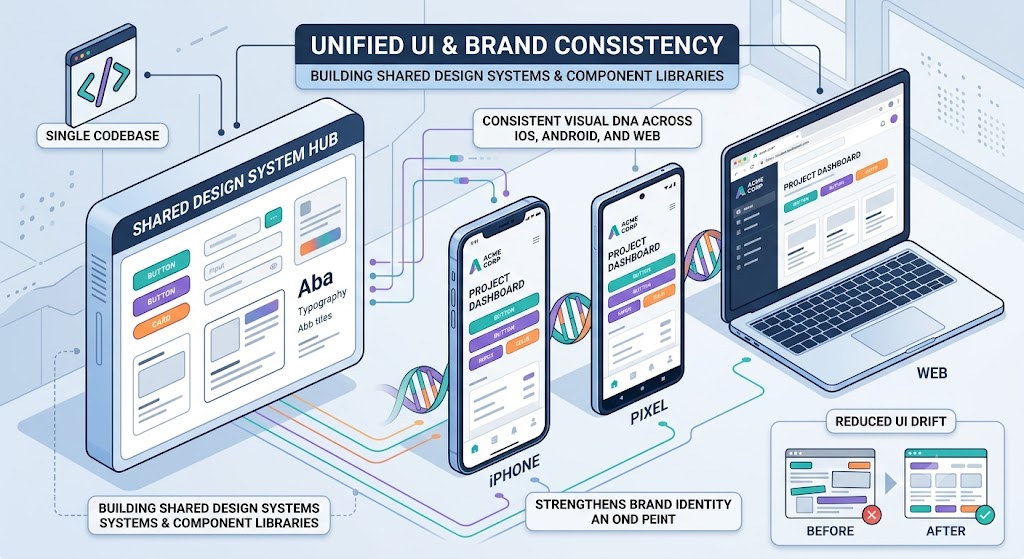
Unified UI & Brand Consistency
A single codebase only delivers value if it actually looks and behaves the same everywhere. We build shared design systems and component libraries so your app’s visual DNA stays consistent across iOS, Android, and web — strengthening brand identity and reducing UI drift over time.
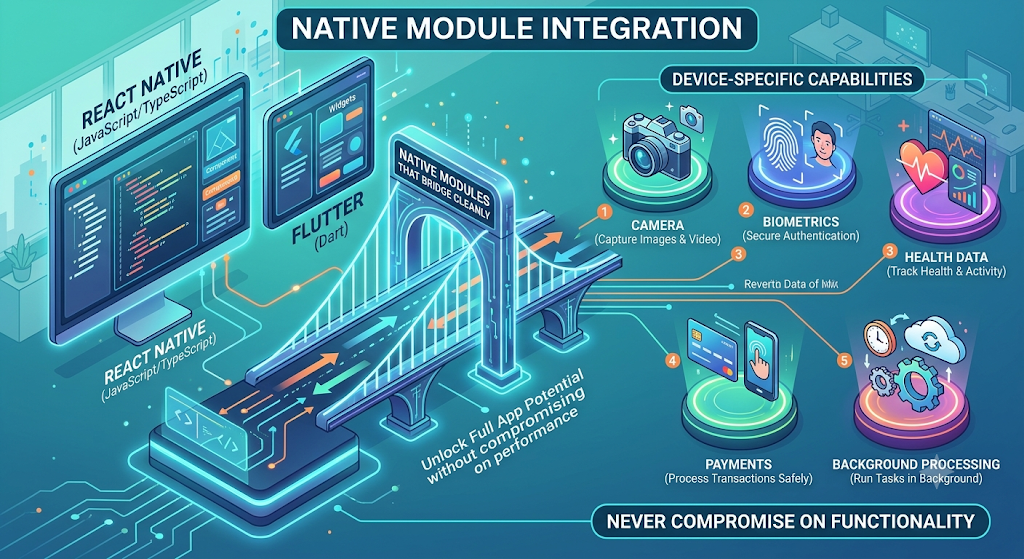
Native Module Integration
Cross-platform doesn’t mean “no native code.” When your app needs device-specific capabilities — camera, biometrics, health data, payments, or background processing — we write native modules that bridge cleanly into your React Native or Flutter app, so you never have to compromise on functionality.
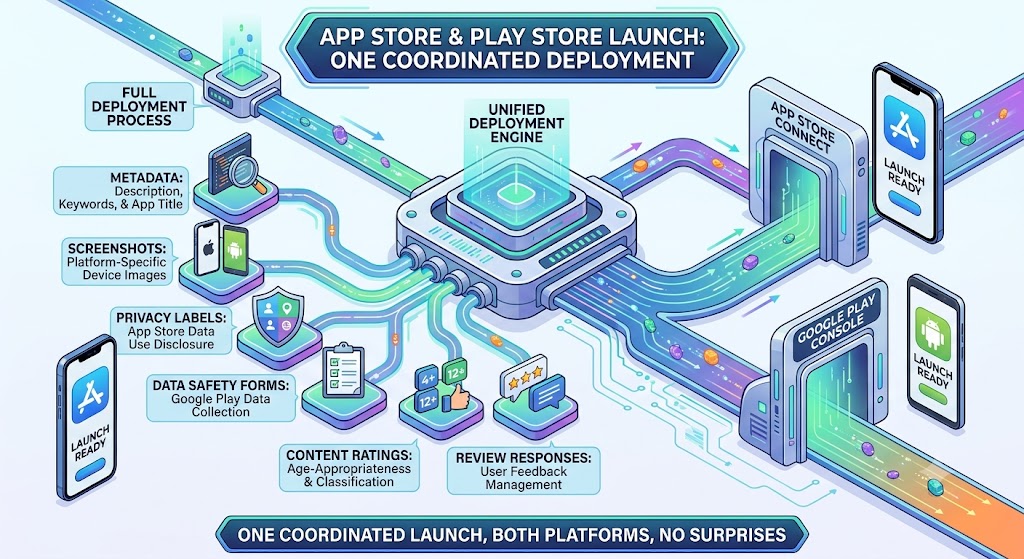
App Store & Play Store Launch
We handle the full deployment process for both stores — App Store Connect and Google Play Console — including metadata, screenshots, privacy labels, data safety forms, content ratings, and review responses. One coordinated launch, both platforms, no surprises.
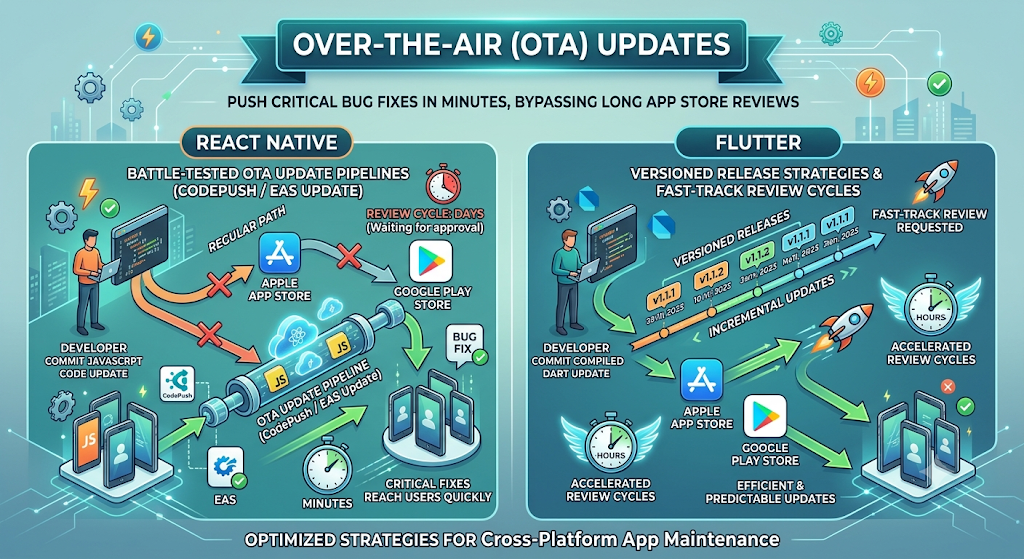
Over-the-Air (OTA) Updates
Need to push a bug fix without waiting days for app store review? For React Native, we set up battle-tested OTA update pipelines (CodePush / EAS Update) so critical fixes reach users in minutes. For Flutter, we implement versioned release strategies and fast-track review cycles.
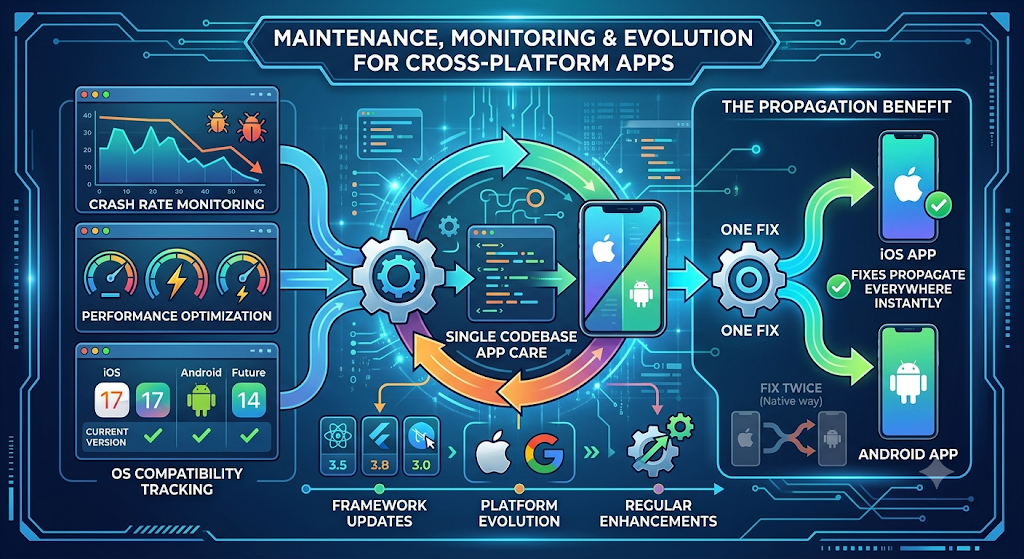
Maintenance, Monitoring & Evolution
A cross-platform app still needs care. We monitor crash rates, performance, and OS compatibility, and keep your single codebase updated as iOS, Android, and the frameworks themselves evolve — so one fix propagates everywhere instead of twice.
Our Development Process
We follow a structured, transparent process — flexible enough to adapt to your reality.
Discovery & Framework Selection —
We assess your product goals, team expertise, performance needs, and platform roadmap to recommend React Native or Flutter honestly. No bias toward whichever we happen to know better.
Architecture & Technical Design —
We define the shared codebase structure, state management, navigation, API integration, and where native modules will be needed.
UI/UX Design & Prototyping —
A unified design system built once, adapted per platform where it matters (Material patterns on Android, Cupertino-style on iOS) so the app feels native on both.
Engineering & Integration —
Agile sprints with stateful hot reload / Fast Refresh, so you see changes in seconds, not weeks.
Testing & QA —
Functional, regression, and cross-device testing on both simulators and real hardware — including OEM-specific quirks that cross-platform frameworks sometimes stumble on.
Dual-Store Launch —
Coordinated App Store and Play Store submission, metadata, and review handling.
Post-Launch & Optimization —
Monitoring, OTA updates where applicable, and continuous improvement based on real user behavior.
Why Choose Technologus
Choosing the right cross-platform partner decides whether your single codebase becomes a real advantage — one app, every platform, lower long-term cost — or a fragile compromise that feels almost native and breaks on real devices. We don’t just pick a framework and code; we engineer unified, high-performing solutions that share most of their logic across iOS, Android, and beyond, stay native where it matters, and evolve with your business — built for performance and maintainability, not trend-chasing.
We Recommend the Framework That Fits — Not the One We Prefer
Most agencies pick the framework their team happens to know and quietly build everything in it, regardless of fit. We don’t. React Native and Flutter have genuinely different strengths: React Native excels when your team knows JavaScript, you have a React web codebase to reuse, or you need broad library access and incremental adoption; Flutter excels for custom animations, pixel-perfect UI parity, performance-critical experiences, and true multi-platform reach beyond mobile. We evaluate your product against those strengths and recommend honestly — even if it means telling you native is the better call.
We Treat Cross-Platform as an Engineering Discipline, Not a Shortcut
Cross-platform done badly produces apps that feel “almost right” — slightly off animations, inconsistent behavior, jank on cheaper Android devices. We engineer for the real-world device matrix your users actually carry, optimizing startup time, frame rates, and memory usage rather than settling for “it runs on the simulator.” With modern tooling — Hermes and Fabric for React Native, AOT compilation and Skia for Flutter — there’s no excuse for a sluggish cross-platform app.
We Bridge to Native Where It Matters
Cross-platform doesn’t mean “no native code.” Camera features, biometric authentication, payments, health data, background tasks, and deep system integrations often require native modules. We write those bridges cleanly and maintainably, so you get the cost savings of a shared codebase without compromising on the features that actually matter to your users.
One Codebase, One Long-Term Partner
A cross-platform app’s real advantage shows up after launch — one fix, one feature, one release for both platforms. We stick around to deliver that advantage: monitoring, OTA updates, compatibility with new OS versions, and continuous evolution from a single codebase. You don’t end up managing two contractors or two roadmaps; you get one accountable partner keeping your app healthy for years, not weeks.
Frequently Asked Questions
It’s the practice of building a single application that runs on multiple platforms — typically iOS and Android, and often web too — from one shared codebase, using frameworks like React Native or Flutter. It reduces duplicate development and maintenance compared to building separate native apps for each platform.
It depends. Choose React Native if your team already knows JavaScript/React, you have a web codebase to reuse, or you need the broadest library ecosystem. Choose Flutter if performance and smooth animations are critical, you need pixel-perfect UI consistency across platforms, or you plan to expand beyond mobile to web, desktop, or IoT. We help you decide during discovery — based on your product, not our preference.
For most business apps — content, commerce, dashboards, tools — yes, they perform well enough that users won’t notice the difference. Modern React Native (with Hermes and Fabric) and Flutter (with AOT compilation and Skia) have largely closed the gap. For extreme performance needs like heavy gaming or AR, native is still the better choice.
You typically share 70–95% of your code across platforms, which can cut development timelines by 40–60% and reduce maintenance overhead significantly. However, apps needing many native modules may see smaller savings. We give you an honest estimate of total cost — including any native work required — before you commit.
Yes. When your app needs device-specific capabilities — camera, biometrics, payments, health data, background processing — we write native modules (in Swift/Kotlin for React Native, or platform channels for Flutter) that integrate cleanly into the shared codebase.
With Flutter, yes — it renders its own UI, so it looks identical everywhere. With React Native, the app uses each platform’s native components, so it feels native on each but may look slightly different. We can design for either approach: true parity or platform-native feel, depending on your brand needs.
For React Native, yes — we set up OTA update pipelines (CodePush / EAS Update) so JavaScript fixes reach users in minutes without a full store review. Flutter doesn’t support OTA in the same way, so we use versioned release strategies and fast-track review cycles for urgent fixes.
Yes. iOS, Android, React Native, Flutter, and the underlying OS versions all evolve. We offer maintenance plans covering compatibility updates, bug fixes, performance monitoring, OTA updates where applicable, and new feature development — all from one codebase, so one fix reaches every platform.
Ready to Engineer Your Next Digital Asset?
Partner with an agency that understands complex business logic, robust database architecture, and uncompromised security. Let's build a software solution tailored exclusively for your operations.
Request a Technical Consultation



















Technologus
- B - 31, Sector - 6 NOIDA (INDIA)
- +91-9873469643 / 9212742139
- sales@technologus.com