- Home
- Services
-
DIGITAL MARKETING
 Search Engine Optimization
  Social Media Optimization
- Guest Posting Service
 Brand Reputation Management
 - Apps Marketing
- Facebook Advertising
 PPC Management
  SEO Migration & Consultancy
  Local Business Listing
WEB DEVELOPMENT
- Core PHP Web Development
- E-Commerce Web Development
 Open Source Development
  Content Management System
 - Database Development
 Website Maintenance
 Website Migration
WEB DESIGN
- Custom Website Design
- E-Commerce Web Design
- Flash Designing
- Facebook Page Design
 Re-Designing
  Logo Designing & Branding
 - PSD to HTML Development
Application Development
 Web Application Development
 - iPhone App Development
- Android App Development
- Window App Development
- Facebook App Development
Other Services
 Content Writing Service
  Hire Dedicated Resource
-
- Packages
- About Us
- Contact Us


Android App Development
At Technologus, we build enterprise-grade, native Android applications designed specifically to thrive in this complex environment. We engineer exclusively in Kotlin and Java, utilizing Google’s official Material Design guidelines to deliver applications that are not only blazingly fast but also intuitively familiar to Android users.
15+
Years Experience500+
Projects Delivered30+
Countries Served99%
Client RetentionRequest a Project Quote
Get a customized technical architecture plan from our experts.
Android App Development – Native Applications for Google Play
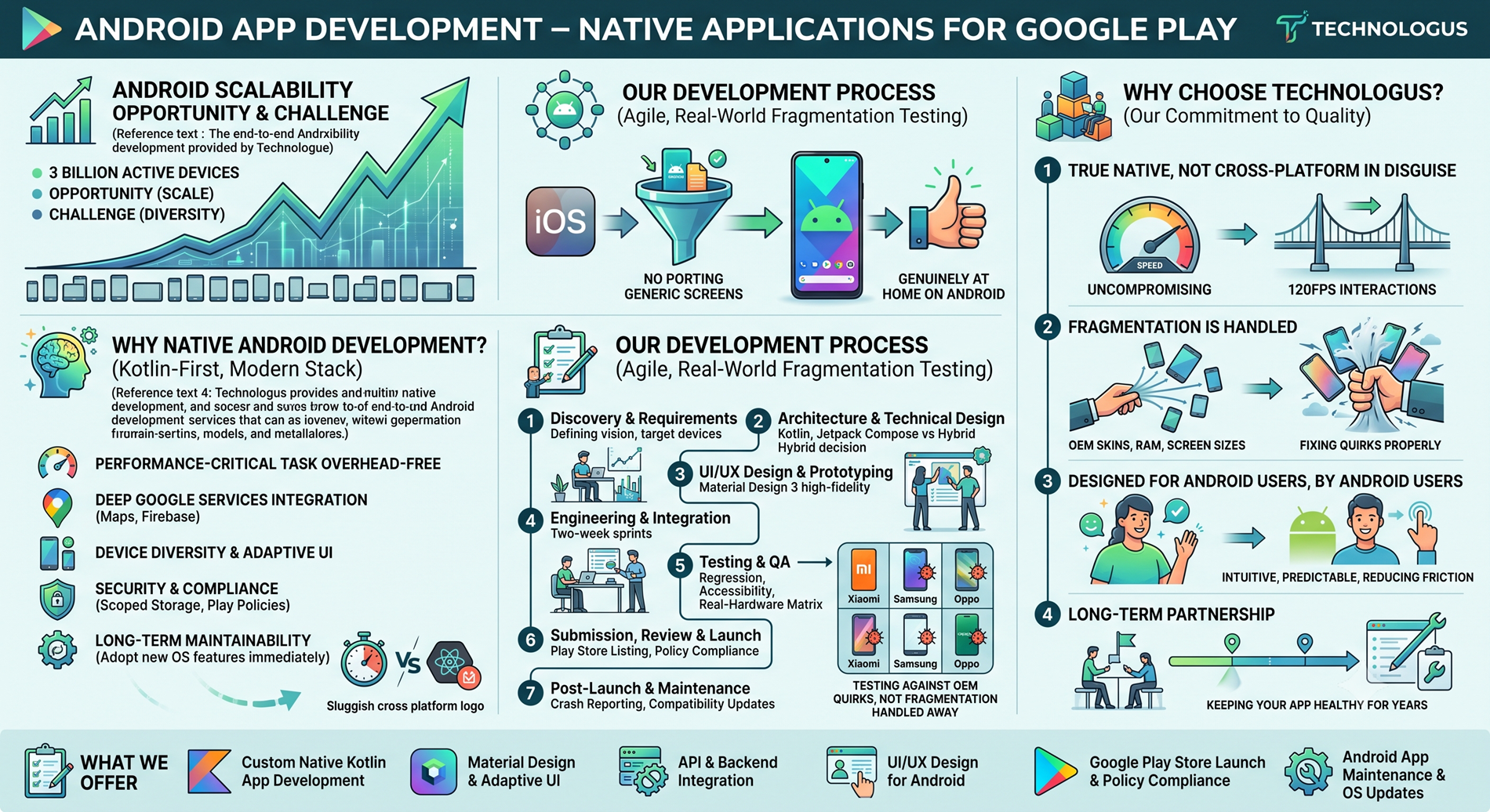
Android runs the world. It powers over 3 billion active devices across every price point, screen size, and hardware configuration you can imagine — from budget smartphones in emerging markets to flagship foldables and tablets.
That scale is a massive opportunity. It’s also a massive challenge.
A great Android app isn’t just an iOS port with a back button. It needs to respect the platform’s design language, perform reliably across thousands of devices, and integrate with Google services users already rely on. At Technologus, we build native Android applications written in Kotlin, using Google’s modern development toolkit — Android Studio, Jetpack Compose, and Material Design — so your app feels fast, secure, and genuinely at home on every Android device.
Whether you’re targeting the Play Store, enterprise distribution, or both — we help you ship something Android users actually want to keep installed.
Why Native Android Development?
Android has the largest device ecosystem on the planet. Building for it requires understanding its unique constraints — device fragmentation, OEM customizations, and battery-sensitive background processing. Native development in Kotlin lets you take full advantage of the platform, keep your app lean, and adopt new Android features the day Google releases them.
Here’s where native Android development stands out:
- Performance-critical apps — Games, camera-heavy apps, real-time audio, and computationally heavy tasks. Native Kotlin runs without the overhead of a cross-platform bridge.
- Deep Google integration — Google Maps, Firebase, Wear OS, Android Auto, and Google Assistant intents. These are built natively and work best natively.
- Device diversity — Android runs on everything from ₹6,000 phones to ₹100,000+ foldables. Native gives you the control to adapt to all of them.
- Security & compliance — Scoped storage, strict background limits, Play Console policies, and updated privacy frameworks every year.
- Long-term maintainability — Google ships new Android features annually. Native apps can adopt them immediately. Cross-platform frameworks often lag months — sometimes years — behind.
If your app will exist for more than a day and quality actually matters, native is the investment that keeps paying off.
What We Offer
Custom Native Android App Development
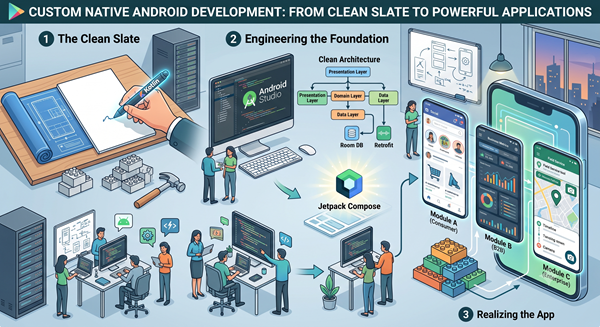
We build Android applications from the clean slate using Kotlin and Jetpack Compose — Google’s recommended and most powerful development stack. Every line of code is written specifically for Android, meaning tighter performance, cleaner architecture, and direct access to every Android API.
Whether it’s a consumer app, a B2B tool, timelines, real-time updates, and an internal enterprise app, we engineer it to feel native because it is native.
Material Design & Adaptive UI
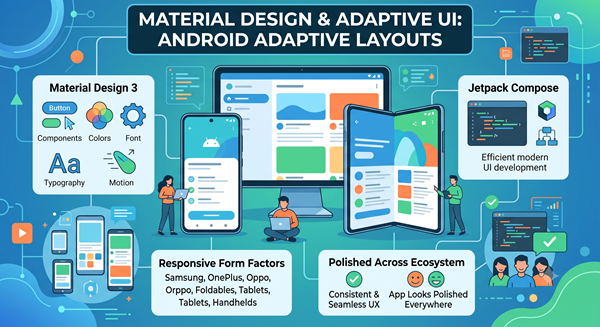
Android isn’t a monolith. It runs on everything from compact phones to large-screen tablets and foldables. We build adaptive layouts that respond to all screen sizes and form factors using Material Design 3 and Jetpack Compose, so your app looks polished across the entire Android ecosystem — not just the latest Google Pixel.
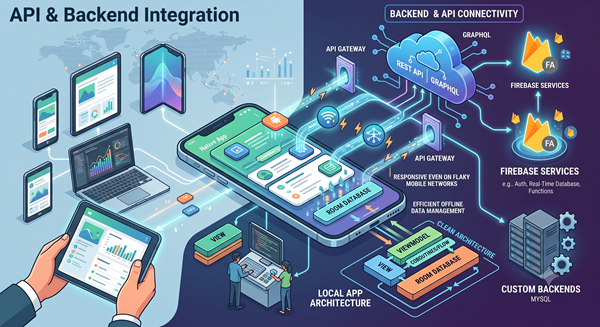
API & Backend Integration
Most apps aren’t standalone. We integrate with REST, GraphQL, Firebase, and custom backends using modern Android architecture components — ViewModels, Coroutines, Flow, and Room database. The result is an app that’s responsive even on flaky mobile networks and efficiently manages data offline.
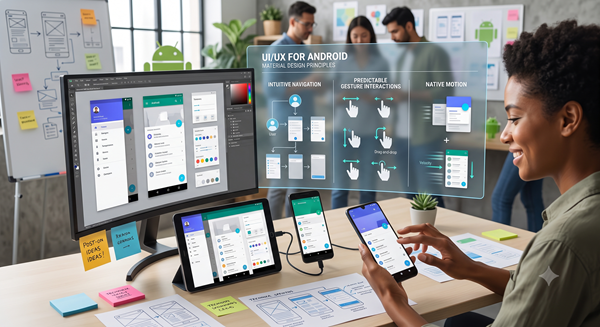
UI/UX Design for Android
Android users have specific expectations. We design interfaces that follow Material Design principles — intuitive navigation patterns, predictable gesture interactions, and motion that feels native to the platform. Users don’t have to learn your app; they just use it.
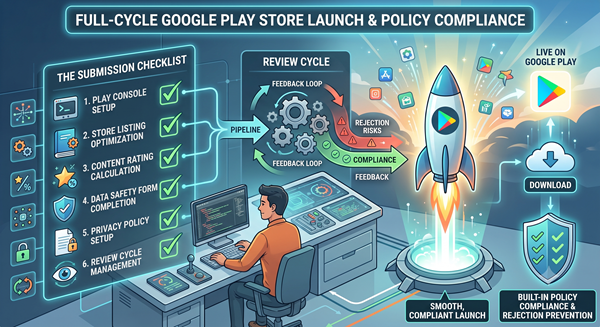
Google Play Store Launch & Policy Compliance
Getting anfully launched on Google Play is not just about generating an APK or AAB. There’s Play Console setup, store listing, content rating, data safety form, privacy policy setup, and review cycles. We handle the entire submission process — Play Console setup, store listing, content rating, data safety form, a privacy policy, and review cycle management — so you launch smoothly and stay compliant.
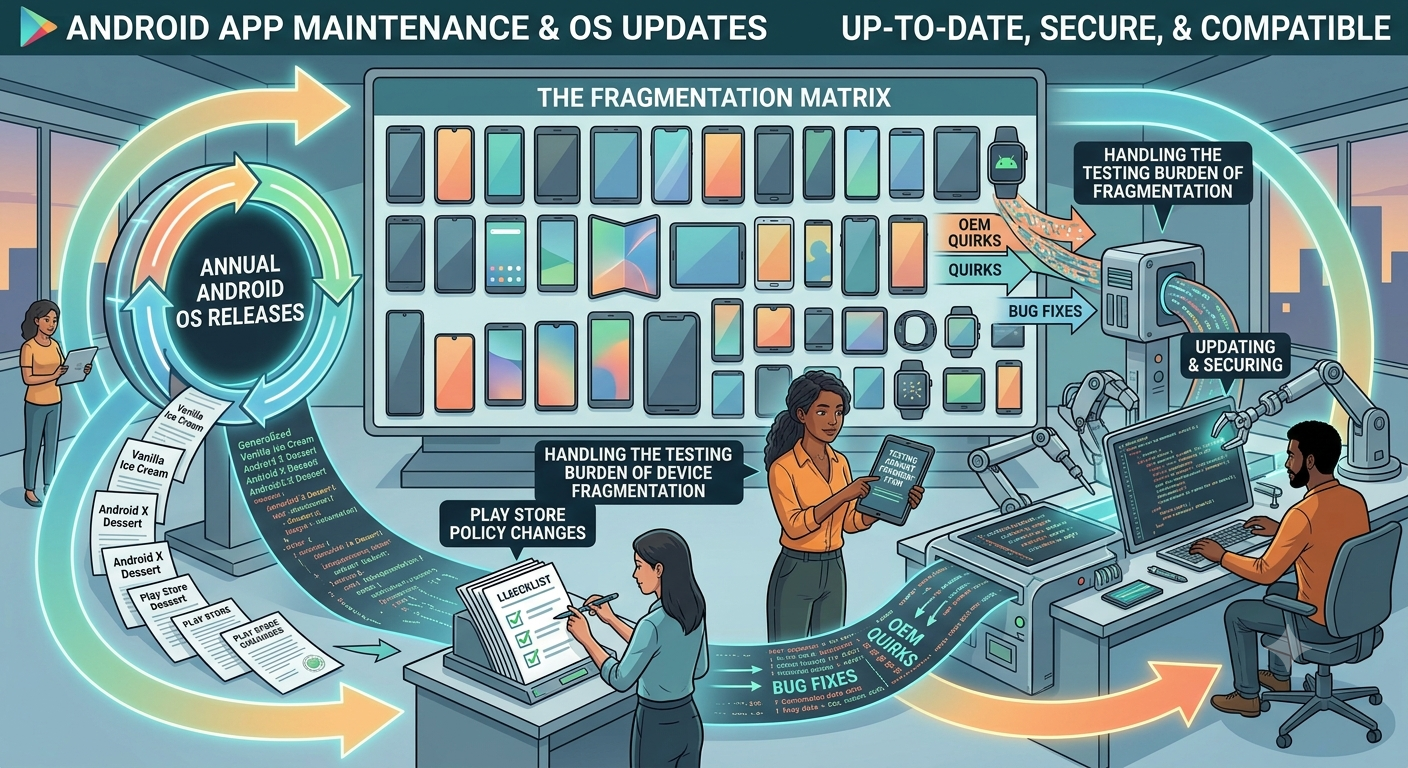
Android App Maintenance & OS Updates
Google ships an annual Android OS release and Play Store policies change frequently. We keep your app updated, secure, and compatible with the latest Android versions — handling the testing burden of device fragmentation so you don’t have to.
Our Development Process
We follow a structured, transparent process — but we stay flexible enough to adapt to your reality.
Discovery & Requirements —
We define the vision, target devices (phones, tablets, Wear OS), distribution channel (Play Store, enterprise MDM, or internal sideloading), success criteria, and technical scope.
** Architecture & Technical Design —
We choose the right framework (Jetpack Compose, classic Views, or hybrid), plan backend connectivity, define data persistence, and map out any third-party integrations or special entitlements (Firebase, Google Maps, Google Cloud services).
UI/UX Design & Prototyping —
Wireframes and high-fidelity designs built to Material Design 3, with interactive prototypes so you can feel the Android app before a single line of production code is written.
Engineering & Integration —
Agile development in two-week sprints. You see progress continuously, not at the answer at the end of six months.
Testing & QA —
Functional, regression, accessibility (TalkBack, WCAG), and device-compatibility testing across Android’s active device matrix — on emulators and real hardware.
Submission, Review & Launch —
Play Store submission handling, including store listing, data safety form, content rating, and review response.
Post-Launch & Maintenance —
Tracking crash reporting and ANR (App Not Responding) rates, compatibility updates, and continuous improvement based on real user behavior.
Why Choose Technologus
Choosing the right development partner dictates whether your custom application becomes a seamless operational asset — trusted, scalable, and future-ready — or an expensive, never-ending headache of bugs, delays, and technical debt. We don’t just write code; we engineer long-term business solutions that evolve with your needs, integrate smoothly into your workflows, and deliver measurable value from day one. From architecture to launch, every decision is made with sustainability, performance, and real-world usability in mind — not just flashy features or short-term wins.
We Build Native — Not Cross-Platform in Disguise
A lot of agencies quietly build your “Android app” in Flutter or React Native and ship a single codebase to both platforms. That’s fine for some cases, but it’s not what we do when native is the right call. We write real Kotlin and Jetpack Compose, which means your app gets the full performance envelope of Android hardware, immediate access to new Android features the day Google releases them, and smooth 120fps interactions that cross-platform bridges simply can’t reliably deliver. When your brand reputation depends on how the app feels, native is non-noucleotide. When your brand reputation depends on how the app feels, native is non-negotiable.
Fragmentation Is Handled. Not Handled Away
Android runs on thousands of device models with varying screen sizes, RAM, chipsets, and OEM software skins (MIUI, One UI, ColorOS). We test against the real-world device matrix your users actually carry, using a combination of real hardware and Firebase Test Lab to catch OEM-specific bugs before your users do. Cross-platform frameworks often struggle with these quirks; native gives us the control to fix them properly.
fragmentation is not fragmentation handled handled away.
We Design for Android Users, by Android Users
We don’t design generic mobile screens and hope they work on Android. Every interaction, animation, and navigation pattern is built around Material Design principles — because that’s what Android users expect. Back button behaves the way Android users expect. Gestures feel natural. The bottom navigation doesn’t conflict with Android’s gesture navigation. This isn’t just aesthetics; it’s about reducing friction so users complete the actions that matter to your business.
We Stay With You After Launch
An Android app is never really “done.” Google ships a major OS update every year, Play Store policies change, and new APIs arrive constantly. Many agencies disappear after the Play Store launch. We stick around — handling compatibility updates, performance tuning, new feature development, and Play Store policy responses so your app stays healthy for years, not just weeks.
Frequently Asked Questions
Native Android development uses Kotlin and Google’s own frameworks (Jetpack Compose, Android Views) to build apps specifically for Android. Cross-platform tools like Flutter or React Native write one codebase that outputs apps for multiple platforms. Native gives you better performance, deeper Google integration, stronger security, and faster access to new Android features — but requires a separate codebase from iOS.
If your application requires high performance, complex animations, heavy data processing, or deep integration with device hardware (like Bluetooth or complex camera features), native development using Kotlin is strongly recommended. Cross-platform apps can struggle with performance in these areas, whereas native apps provide the most seamless and responsive experience.
We maintain a test matrix of common devices — covering the most popular OEMs and chipsets — and validate on both emulators and real hardware. For broader coverage, we use Firebase Test Lab to run automated tests across hundreds of devices without manually clicking buttons.
We handle the entire UI/UX design process. Our design team specializes in Google's Material Design system, ensuring the final product is not only visually stunning but also highly intuitive and compliant with Android platform standards.
Fragmentation is the biggest challenge in Android development. We solve this through dynamic, responsive UI design that adapts fluidly to different screen dimensions. Furthermore, we conduct rigorous testing across a wide array of physical devices and emulators to ensure consistent performance.
Yes. We manage the entire process — AAB upload, Play Console setup, store listing, content rating, data safety form, privacy policy, and responding to review feedback. You stay informed the whole way.
Absolutely. We regularly take over existing codebases — including Java apps that need modernizing to Kotlin, apps with technical debt, or projects abandoned by a previous developer. We audit first, then stabilize and improve.
It can. We build adaptive apps that adapt to phones, tablets, and Wear OS. We’ll discuss your target devices during discovery and recommend the right scope — sometimes tablet or Wear OS support makes sense, sometimes it’s a later phase.
Yes, we manage the complete submission and launch process. We ensure your application meets all of Google’s strict developer guidelines to prevent rejection, and we assist with the initial setup of your app’s metadata for optimal store visibility.
Yes. Google releases a major Android update annually, which means apps need regular compatibility checks and updates. We offer maintenance plans that cover OS updates, bug fixes, crash reporting, ANR reduction, and new feature development.
Ready to Engineer Your Next Digital Asset?
Partner with an agency that understands complex business logic, robust database architecture, and uncompromised security. Let's build a software solution tailored exclusively for your operations.
Request a Technical Consultation



















Technologus
- B - 31, Sector - 6 NOIDA (INDIA)
- +91-9873469643 / 9212742139
- sales@technologus.com