Search Engine Optimization (SEO) Services
Engineering scalable, secure, and high-performance web applications tailored to your exact operational requirements.
15+
Years Experience500+
Projects Delivered30+
Countries Served99%
Client RetentionRequest a Project Quote
Get a customized technical architecture plan from our experts.
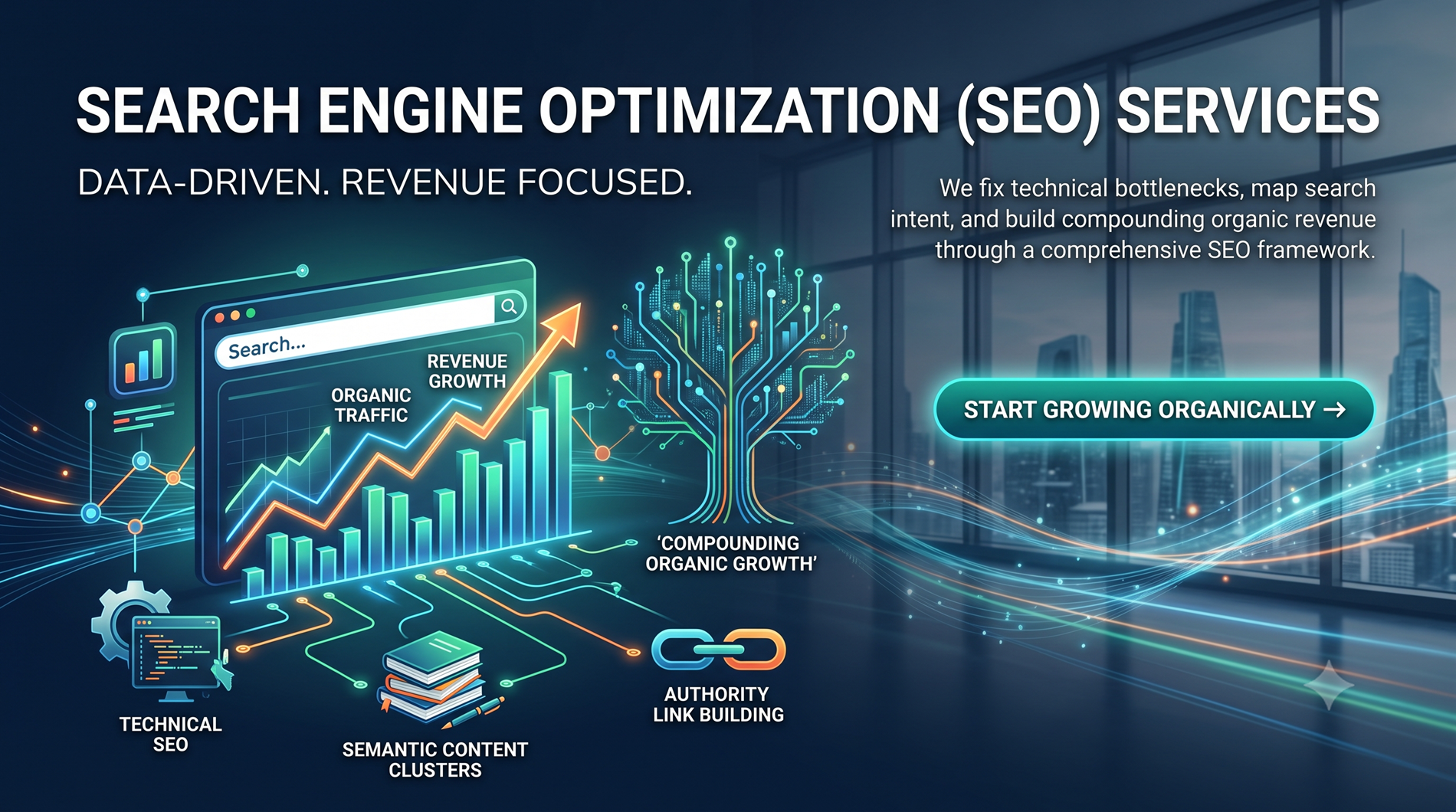
Search Engine Optimization (SEO) Services
Search Engine Optimization isn’t a buzzword or a once-a-year “set it and forget it” task. At its core, SEO is the practice of making your website genuinely useful — to the people who land on it and to the search engines that decide whether to show it to anyone at all.
Think about how you find things online. You type a question into Google, scan the first few results, and usually click one of the top three. Rarely do you scroll to page two. In fact, industry studies consistently show that the first result on Google captures roughly 28% of clicks, and fewer than 1% of users ever make it to the second page.
That’s the entire game. If your business isn’t on page one for the searches your customers actually make, you might as well not exist online. SEO is what moves you up that page — not by tricking Google, but by building a site that deserves to rank.
The Real Problem Most Websites Face
Here’s the uncomfortable truth most businesses discover too late: having a website isn’t the same as having a visible website. You can spend thousands on a beautiful design, fast hosting, and clever copy. But if Google can’t figure out what your pages are about, or if the content doesn’t match what people are searching for, all that work sits in a digital ghost town. A website nobody finds is a brochure printed and locked in a drawer.
The businesses that win online share a few things in common. They show up for the right searches. Their pages load fast and work well on a phone. Their content answers real questions. And they’ve built enough trust — through links, structure, and authority — that search engines confidently recommend them.
That’s not luck. It’s a system. And it’s exactly the system we build for our clients.
How Search Engines Actually Work
If you understand how Google decides what to show, everything else about SEO clicks into place.
Search engines do three things, over and over:
Crawling — Automated programs (often called “spiders” or “bots”) move through the internet by following links, visiting pages, and reading what’s on them.
Indexing — The pages they visit get stored in a massive database. If your page isn’t indexed, it can’t appear in any search result, no matter how good it is.
Ranking — When someone searches, the engine scans its index and ranks pages based on relevance, quality, and authority. This is where hundreds of signals come into play: keywords, page speed, mobile-friendliness, backlinks, user behavior, and more.
None of this is done “manually” by a human at Google. It’s a constantly evolving algorithm. Our job is to make sure your site is easy to crawl, quick to index, and impossible to ignore when it comes to ranking.
The Technologus SEO Framework
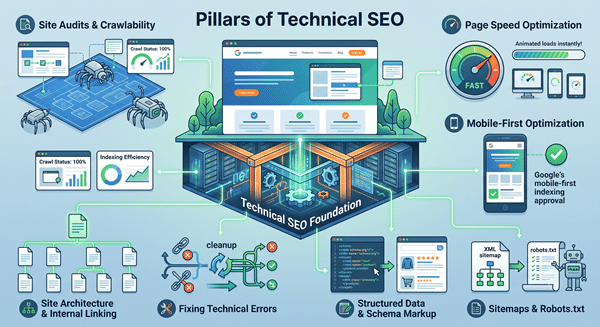
Technical SEO
- Site audits — We map out every crawl, indexing, and structure issue holding you back.
- Page speed optimization — Slow pages lose visitors and rankings. We make yours load fast on every device.
- Mobile-first optimization — Google ranks the mobile version of your site. We make sure it's flawless.
- Site architecture and internal linking — We organize your pages so both users and bots find the right content easily.
- Fix crawl errors, redirects, and broken links — Cleaning up the technical debt that silently drags your site down.
- Structured data / schema markup — Helping search engines display rich results, review stars, and other eye-catching details.
- XML sitemap and robots.txt setup — Telling search engines exactly what to read and what to skip.
On-Page SEO
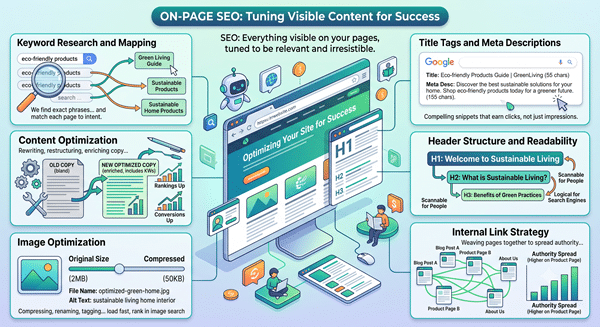
Everything visible on your pages, tuned to be relevant and irresistible.
- Keyword research and mapping — We find the exact phrases your customers search for and match each page to the right intent.
- Title tags and meta descriptions — Writing compelling snippets that earn clicks, not just impressions.
- Content optimization — Rewriting, restructuring, and enriching your copy to rank and convert.
- Header structure and readability — Making content scannable for people and logical for search engines.
- Image optimization — Compressing, renaming, and tagging images so they load fast and rank in image search.
- Internal link strategy — Weaving your pages together to spread authority where it matters most.
Content Strategy & SEO Copywriting
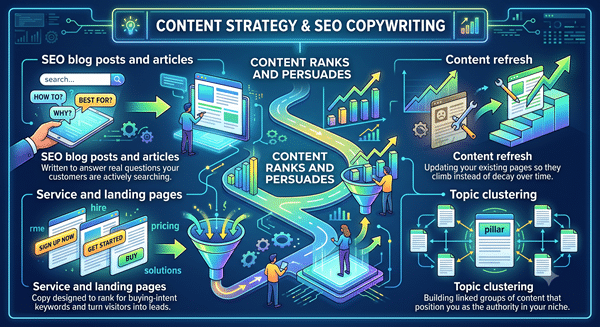
Content is what search engines rank. But only good content actually wins. We produce material that ranks AND persuades.
- SEO blog posts and articles — Written to answer real questions your customers are actively searching.
- Service and landing pages — Copy designed to rank for buying-intent keywords and turn visitors into leads.
- Content refresh — Updating your existing pages so they climb instead of decay over time.
- Topic clustering — Building linked groups of content that position you as the authority in your niche.
Off-Page SEO & Link Building
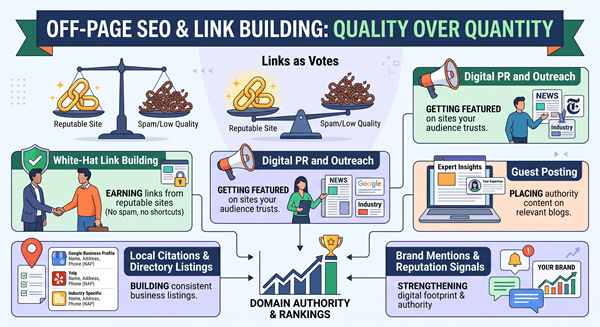
Google treats links like votes of confidence. But quality matters infinitely more than quantity.
- White-hat link building — Earning links from relevant, reputable websites — no spam, no shortcuts.
- Digital PR and outreach — Getting your business featured on sites your audience already trusts.
- Guest posting on relevant blogs — Placing your expertise where it earns visibility and authority.
- Local citations and directory listings — Building consistent name, address, and phone information across the web.
- Brand mentions and reputation signals — Strengthening the digital footprint that search engines reward.
Local SEO
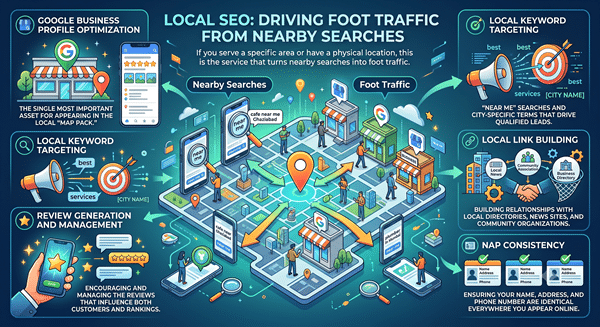
If you serve a specific area or have a physical location, this is the service that turns nearby searches into foot traffic.
- Google Business Profile optimization — The single most important asset for appearing in the local "map pack."
- Local keyword targeting — "near me" searches and city-specific terms that drive qualified leads.
- Review generation and management — Encouraging and managing the reviews that influence both customers and rankings.
- Local link building — Building relationships with local directories, news sites, and community organizations.
- NAP consistency — Ensuring your name, address, and phone number are identical everywhere you appear online.
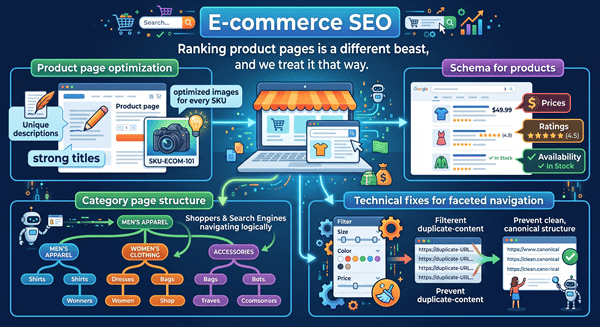
E-commerce SEO
Ranking product pages is a different beast, and we treat it that way.
- Product page optimization — Unique descriptions, strong titles, and optimized images for every SKU.
- Category page structure — Helping shoppers and search engines navigate your catalog logically.
- Technical fixes for faceted navigation — Preventing duplicate-content issues that cripple online stores.
- Schema for products — Getting prices, ratings, and availability to show right in search results.
The SEO Process, Step by Step
Discovery & Audit
We dig into your website, your industry, your competitors, and your current rankings. This gives us a baseline and a clear picture of what we're up against.
Strategy & Roadmap
We build a prioritized plan: what to fix first, what to build over time, and what success will look like. No guesswork — a written roadmap you approve before we start.
Implementation
Technical fixes, on-page optimization, content creation, and link building begin. This is where most of our time goes — actually doing the work
Monitoring & Refinement
SEO never stops. We track rankings, traffic, and conversions weekly, then adjust. What's working gets more resources; what's not gets fixed.
Reporting & Scaling
You get clear monthly reports. As results compound, we scale what's winning and expand into new keywords, new content topics, and new opportunities.
How We Measure Success
Vanity metrics waste your money. Here’s what we actually track:
- Organic traffic — People arriving through unpaid search results
- Keyword rankings — Your position for the terms that drive business
- Conversion rate — How many visitors turn into leads or customers
- Revenue from organic search — The bottom-line number that matters most
- Click-through rate (CTR) — How often people click your listing when they see it
- Domain authority and backlink growth — The trust signals that underpin long-term success
If a metric doesn’t eventually point back to revenue, we don’t bother you with it.
Common SEO Mistakes We Fix
New clients come to us with the same problems again and again. Here are the big ones:
- Ignoring mobile — Over 60% of searches now happen on phones. If your site isn’t mobile-first, you’re invisible to most of your audience.
- Targeting the wrong keywords — Ranking #1 for a phrase nobody searches is worthless. We target keywords with real buying intent.
- Duplicate or thin content — Pages with little substance (or copies of each other) confuse search engines and lose rankings.
- A slow website — If your page takes more than a few seconds to load, visitors leave — and Google notices.
- No internal linking — Without links between your own pages, search engines struggle to understand your site’s structure and importance.
- Buying spammy links — Cheap, low-quality links can trigger penalties that take months to recover from. We build links the right way.
- Ignoring local search — Businesses with physical locations routinely miss out on the “map pack” because their Google Business Profile is neglected.
Why Choose Technologus
There are a thousand agencies that "do SEO." Here's why clients stay with Technologus.
We do the work, not just the reports.
Plenty of agencies will hand you a fancy 40-page audit and a dashboard, then consider the job done. That's not SEO — that's paperwork. At Technologus, we get our hands dirty. We fix the technical issues, rewrite the content, build the links, and push changes live. You hire us to improve your rankings, and that's exactly what we focus on every single month.
Honest, transparent reporting you can actually understand.
No vanity metrics like "number of backlinks created" or screenshots of rankings nobody searched for. We report on what matters: organic traffic, keyword rankings, qualified leads, and revenue impact. We tell you what's working, what isn't, and what we're doing about it — in plain language. If a strategy isn't producing results, we say so and change course.
We play the long game, the right way.
SEO is a marathon, not a sprint, and anyone promising overnight rankings is either misleading you or using tactics that will eventually get your site penalized. We use only white-hat, sustainable strategies that Google rewards over time. The results may not land in week one, but they compound. Our clients don't see a spike and then a crash — they see steady, durable growth.
Strategy built around your business, not a template.
A dentist, a SaaS company, and an online furniture store have almost nothing in common when it comes to SEO. So why would the approach be identical? Every Technologus engagement starts with understanding your market, your competitors, and your customers. From there, we design a custom strategy — because what works for a local bakery won't rank a national logistics firm.
Frequently Asked Questions
Most businesses see meaningful movement in 3 to 6 months, with more significant results building over 6 to 12 months. SEO is a compounding investment. It depends heavily on your starting point, how competitive your market is, and how consistently the work is done. Anyone promising #1 rankings in two weeks is not being honest with you.
No — and this is the mistake that costs people their rankings. Your competitors aren't stopping, and search engines are constantly updating their algorithms. If you stop, you'll gradually slip. Think of SEO like a gym membership for your website: the results are great while you keep showing up, but they fade quickly when you quit.
Paid ads deliver immediate traffic but stop the instant you stop paying. SEO takes longer to build momentum, but the results compound and persist over time. The best strategy for most businesses is to use both: ads for quick wins and testing, SEO for sustainable long-term growth. At Technologus, while we focus on SEO, we help you understand how the two channels work together.
We recommend thinking in terms of at least 6 months, because that's the realistic timeline for SEO to produce meaningful results. We're happy to discuss flexible arrangements, but be wary of any agency offering SEO on a one-month basis — it's usually a sign they don't expect to deliver results.
In our experience, past SEO failures almost always come down to a few things: targeting the wrong keywords, bad technical foundations, low-quality links, or an agency that didn't actually do the work. Our first step is a thorough audit to identify exactly what went wrong before, so we don't repeat the same mistakes.
Absolutely — in many ways, small local businesses have the most to gain. While big brands fight for broad national keywords, local businesses can win highly profitable "near me" and city-specific searches with relatively modest effort. Local SEO consistently delivers one of the best returns on investment available to small business owners.
No, and you should be skeptical of anyone who does. No legitimate SEO provider can guarantee specific rankings, because search engines' algorithms are outside anyone's control and are constantly changing. What we do guarantee is honest work, transparent reporting, and a clear strategy — the things that actually produce lasting results.
To begin, we'll need access to your website (analytics, search console, and content management system), some background on your business and goals, and ideally a clear picture of your ideal customer. The more context you share, the faster we can build an effective strategy. We'll walk you through the setup step by step.
Trusted by innovative agencies and enterprise teams worldwide