- Home
- Services
-
DIGITAL MARKETING
 Search Engine Optimization
  Social Media Optimization
- Guest Posting Service
 Brand Reputation Management
 - Apps Marketing
- Facebook Advertising
 PPC Management
  SEO Migration & Consultancy
  Local Business Listing
WEB DEVELOPMENT
- Core PHP Web Development
- E-Commerce Web Development
 Open Source Development
  Content Management System
 - Database Development
 Website Maintenance
 Website Migration
WEB DESIGN
- Custom Website Design
- E-Commerce Web Design
- Flash Designing
- Facebook Page Design
 Re-Designing
  Logo Designing & Branding
 - PSD to HTML Development
Application Development
 Web Application Development
 - iPhone App Development
- Android App Development
- Window App Development
- Facebook App Development
Other Services
 Content Writing Service
  Hire Dedicated Resource
-
- Packages
- About Us
- Contact Us


AI Chatbot & Automation Integration
We engineer intelligent AI chatbots and workflow automations that eliminate prolonged wait times and remove manual bottlenecks.
15+
Years Experience500+
Projects Delivered30+
Countries Served99%
Client RetentionRequest a Project Quote
Get a customized technical architecture plan from our experts.
AI Chatbot & Automation Integration: Intelligent Conversational Agents and Workflows
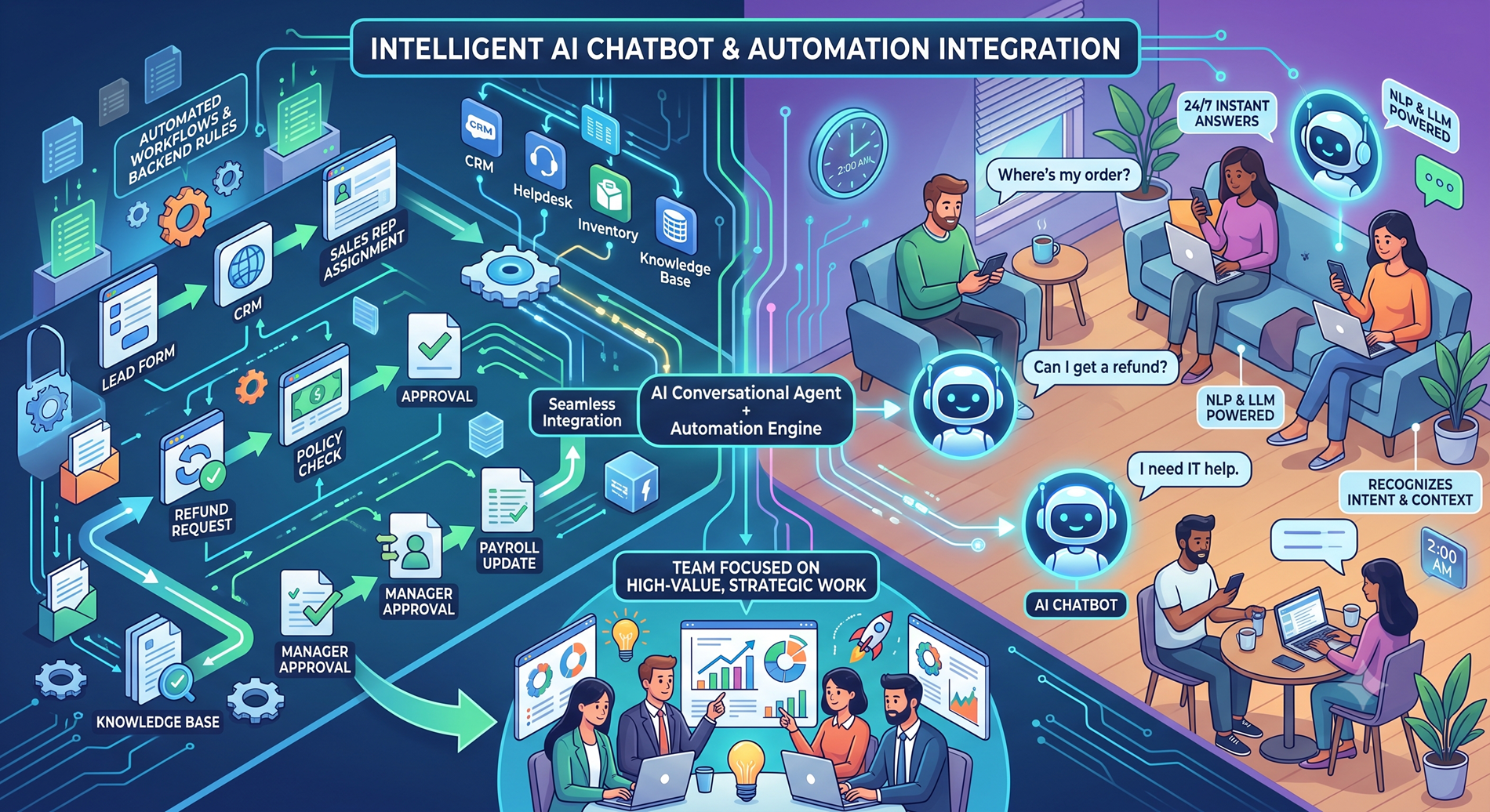
When customer support requests pile up and your team is bogged down by repetitive data entry, your business loses momentum. We engineer intelligent AI chatbots and workflow automations that eliminate prolonged wait times and remove manual bottlenecks. By deploying smart conversational agents and automating backend rules, we free your team to focus on high-value, strategic work while ensuring your customers get instant, accurate answers around the clock.
What Is an AI Chatbot, Really?
An AI chatbot is software that simulates human-like conversation, typically through text or voice, to help users get information, complete tasks, or solve problems — without waiting for a human agent. But that basic definition undersells what’s possible today.
Modern AI chatbots, built on large language models and natural language processing (NLP), can
- Understand intent even when a question is phrased awkwardly or informally
- Maintain context across a multi-turn conversation
- Pull live data from your CRM, order system, or knowledge base to give accurate answers
- Recognize when they’re out of their depth and escalate to a human seamlessly
- Learn and improve from ongoing interactions
There’s a real difference between a rule-based bot (which follows rigid decision trees — “press 1 for billing”) and an AI-driven conversational agent (which actually understands what you’re asking, regardless of how you phrase it). The industry has largely moved toward the latter, and for good reason: it’s the difference between a bot that frustrates people and one that genuinely helps them.
And What Does “Automation” Mean in This Context?
Automation is the quieter half of this equation, and honestly, it might be the more valuable one for many businesses. While chatbots handle the conversation, automation handles the workflow behind the scenes — the repetitive, rules-based tasks that eat up hours of human time every week.
Think about things like:
- A new lead fills out a form → automatically added to your CRM → assigned to a sales rep → follow-up email scheduled
- A customer requests a refund → automatically checked against policy → approved or flagged for review → confirmation sent
- An employee submits a leave request → routed to the right manager → approved → calendar and payroll updated
None of this requires human judgment for the vast majority of cases. Automation platforms (often paired with AI decision-making) handle it end-to-end, and humans only step in for exceptions.
When you combine a conversational AI agent with backend automation, you get something powerful: a system that can talk to customers or employees and actually get things done on their behalf, instead of just relaying information.
The Technology Stack Behind Smart Chatbots
It helps to understand what’s actually happening under the hood, because it explains why quality varies so wildly between chatbots.
Natural Language Processing (NLP): This is what allows the bot to parse human language — slang, typos, incomplete sentences — and extract meaning from it.
Large Language Models (LLMs): Modern chatbots are increasingly powered by LLMs (like GPT-based models), which give them a far richer understanding of context and nuance than older rule-based systems.
Intent Recognition & Entity Extraction: The bot identifies what the user wants (intent) and pulls out the relevant details (entities) — like a date, product name, or order number.
Integration Layer: This connects the bot to your actual business systems — CRM, helpdesk, inventory, payment gateway — so it’s not just chatting, it’s acting on real data.
Retrieval-Augmented Generation (RAG): For businesses with a lot of internal documentation, RAG lets the bot pull accurate, up-to-date answers from your own knowledge base instead of relying purely on general training data. This dramatically reduces made-up or outdated answers.
Workflow/Automation Engine: Tools like this trigger the actual business processes — updating records, sending notifications, generating reports — once the bot understands what needs to happen.
Key Benefits of AI Chatbot & Automation Integration
Round-the-clock availability. Customers don’t operate on your business hours, and now they don’t have to wait for yours either. A well-built chatbot answers questions at 2 AM just as capably as at 2 PM.
Faster response times. Studies consistently show customers rate response speed as one of the biggest drivers of satisfaction. Bots respond instantly; automation executes instantly. That’s a huge win over manual processes that queue for hours or days.
Lower operational costs. Every routine query a bot handles is one your team doesn’t have to. Businesses that deploy chatbots for tier-1 support routinely report significant reductions in support costs.
Consistency at scale. A human agent might have an off day. A well-trained bot gives the same accurate, policy-compliant answer every single time, to every single customer, regardless of volume.
Fewer human errors. Manual data entry, copy-pasting between systems, forgetting to send a follow-up — automation eliminates these entirely by design.
Better use of human talent. When bots absorb the repetitive stuff, your team gets to spend their time on complex, high-value conversations that actually need a human — the ones where empathy, judgment, and creativity matter.
Valuable data and insights. Every conversation is a data point. Patterns in customer questions, common pain points, and workflow bottlenecks become visible in ways that scattered human interactions never revealed.
Where AI Chatbots and Automation Actually Get Used
This isn’t a one-industry story. Here’s where it’s making a real dent:
- Customer support: Handling FAQs, order tracking, returns, and troubleshooting, escalating only genuinely complex issues to human agents.
- Sales & lead qualification: Engaging website visitors in real time, qualifying leads based on their answers, and routing hot leads straight to sales reps.
- HR & internal operations: Automating onboarding paperwork, leave requests, IT ticket routing, and policy Q&A for employees.
- E-commerce: Product recommendations, order status updates, abandoned cart recovery messages, and post-purchase support.
- Healthcare: Appointment scheduling, symptom triage, prescription refill reminders, and insurance FAQs.
- Finance & banking: Balance inquiries, fraud alerts, loan application status, and basic transaction support.
- Real estate: Property inquiries, scheduling site visits, and pre-qualifying buyers based on budget and preferences.
- Internal workflow automation: Invoice approvals, report generation, data syncing between tools, and notification chains that used to require someone remembering to hit “send.”
Chatbot vs. Live Chat vs. Full Automation — What’s the Difference?
People often lump these together, but they solve different problems.
| Aspect | Live Chat (Human) | AI Chatbot | Workflow Automation |
|---|---|---|---|
| Availability | Business hours only | 24/7 | 24/7 |
| Handles conversation | Yes | Yes | No |
| Handles backend tasks | Rarely directly | Sometimes, via integration | Yes, entirely |
| Scalability | Limited by headcount | Unlimited | Unlimited |
| Cost per interaction | High | Low | Very low |
| Best for | Complex, emotional, high-stakes issues | Repetitive queries, FAQs, guided tasks | Repetitive processes, data movement, approvals |
The smartest setups don’t pick one — they layer all three. The bot handles the front door, automation runs the machinery behind it, and humans step in exactly where they add the most value.
Why Choose Technologus
We Design for Real Conversations, Not Scripted Dead Ends
A lot of chatbots fail because they're built around rigid decision trees that break the moment a user phrases something unexpectedly. We build conversational agents powered by modern NLP and LLM technology, trained specifically on your business context — your products, your policies, your tone of voice. That means fewer dead ends, fewer "I'm sorry, I didn't understand that" moments, and a bot that actually feels like it belongs to your brand rather than a generic template dropped onto your website.
We Connect the Bot to Your Actual Systems, Not Just a Script
A chatbot that can only answer generic questions is only half useful. Our real strength is integration — connecting your AI agent directly to your CRM, helpdesk, inventory, payment systems, and internal databases so it can actually check order status, update records, or trigger a workflow, not just talk about it. This is where the real ROI lives: a bot that can genuinely resolve issues end-to-end, not just describe what the customer should do next.
Automation Built Around Your Actual Workflows, Not a Generic Template
Every business has its own quirks — approval chains, exception cases, specific compliance needs. We don't hand you an out-of-the-box automation template and call it done. We map your real processes first, identify where automation genuinely saves time (and where it doesn't), and build workflows that fit how your team actually operates. The goal is fewer manual handoffs and fewer things falling through the cracks — not automation for automation's sake.
Continuous Optimization After Launch
Chatbots and automations aren't "set it and forget it" tools — they get better with tuning, and user behavior shifts over time. Technologus stays involved post-launch: reviewing conversation logs, identifying where the bot struggles, retraining on new data, and refining automation rules as your business evolves. We treat this as an ongoing partnership focused on measurable outcomes — reduced response times, higher resolution rates, and real hours saved — not a one-time build we walk away from.
Frequently Asked Questions
The terms are often used interchangeably, but generally a chatbot is focused on answering questions and guiding conversations, while a virtual assistant tends to also perform actions on the user's behalf (booking, ordering, updating records). Modern AI chatbots increasingly do both.
Yes, and it should be. Using techniques like retrieval-augmented generation, a chatbot can be trained on your product catalog, FAQs, policies, and support history so its answers are accurate and specific to your business — not generic.
A focused, well-scoped chatbot handling a defined set of use cases can typically launch in a few weeks. More complex agents with deep system integrations and automation workflows may take a couple of months. Timeline depends heavily on how many systems need connecting.
Best practice is to be transparent — most users prefer knowing upfront, and it actually builds trust rather than eroding it. A good bot doesn't need to pretend to be human to be effective; it just needs to solve the problem quickly.
Not entirely, and it shouldn't try to. Automation is best suited to rules-based, repeatable tasks. For decisions requiring nuance, empathy, or judgment, the smart approach is to automate the routine parts and route exceptions to a human.
A well-designed system recognizes its own limits and escalates — handing off to a human agent with full conversation context, so the customer doesn't have to repeat themselves. This handoff quality is one of the biggest differentiators between good and bad implementations.
Not necessarily. With modern LLM-based approaches and retrieval-augmented generation, even a well-organized knowledge base or existing support documentation can be enough to get a highly capable bot running. It's quality and relevance that matter more than raw volume.
Key metrics include resolution rate (queries fully handled without escalation), response time, customer satisfaction scores, deflection rate (queries kept away from human agents), and time saved on automated workflows. We help set these benchmarks upfront so results are measurable, not anecdotal.
We handle sensitive customer data. Security should be built in from the start — data encryption, access controls, and compliance with relevant regulations (like GDPR or HIPAA, depending on your industry) are non-negotiable in any implementation we design.
Yes. One of the biggest advantages of modern chatbot and automation platforms is broad integration support across messaging platforms, CRMs, helpdesks, and internal tools. We assess your existing stack early on to make sure everything connects cleanly.
Ready to Engineer Your Next Digital Asset?
Partner with an agency that understands complex business logic, robust database architecture, and uncompromised security. Let's build a software solution tailored exclusively for your operations.
Request a Technical Consultation



















Technologus
- B - 31, Sector - 6 NOIDA (INDIA)
- +91-9873469643 / 9212742139
- sales@technologus.com